Past Big Bands
The Big Band era was a time when the social hub of a community was the local dance hall. A place where people could relax, listen to the music of their favourite swing band or dance band, and form lifelong attachments with members of the opposite sex. A place where one could linger for a while and escape from the tensions of daily life. And as the years passed by and other attractions moved in to replace the dance hall, people could still look back with nostalgia on those days and relive them by going to dances whenever the opportunity arose.
These opportunities have survived in London right up to the present day. Credit must go to the many big bands that have kept the spirit alive in the city over the passing years, bands that were composed of highly skilled musicians, many of whom played with the same band all their lives. When Johnny Downes Orchestra ceased playing in 1985 six of the members had been with him since their first engagement in 1939.
Visit the pages of the big bands, listen to the audio clips, many from live broadcasts from local ballrooms, view the photographic slideshows, relive those glorious days, create your own nostalgia and remember that the City of London was fortunate enough to be the home of so many great bands. **much of this content thanks to Al Shipley**
Buescher Boys Band
This orchestra formed in 1926 was under the direction of Hugo D'ippolito and consisted of some of London's finest young musicians. It was sponsored by the Buescher Instrument Company, famous for its saxophones (later taken over by Selmer). All of the personnel in the accompnaying photograph were to become famous musicians - including Bert Niosi, his brother Joe (bassist), Tony Briglia (drummer, later a founding member of the Casa Loma Orchestra), and Hugo D'Ippolito (pianist, later a member of the Royal Canadians).
The band played for the season at Grand Bend Casino.

Phil Murphy Big Band
As one of London’s best known musicians, Phil Murphy has made a substantial impact within the community. He is renowned for his contributions as music educator, performer, conductor and adjudicator, with versatility which finds him as comfortable with the genres of classical, theatrical, jazz or Klezmer music, working as easily with young students as with seasoned musicians.
Phil has been most influential in his role of educator. Many of his former students working around the world in the field of music acknowledge Phil as a major role model in their career decisions.
Today, Phil continues to enjoy performing around the province. His Big Band and small ensembles are frequently heard throughout the community. For nineteen years he was principal clarinettist for the London Symphony Orchestra. He has been a featured soloist with many orchestras, and has performed on numerous CDs.
Phil’s contributions to the community are extensive. He worked with Theatre London and Purple Patches at Western for many years. He has been a member of the board of directors for the London Kiwanis Music Festival and has traveled across North America as an adjudicator, clinician and lecturer. In 1999 he was recognized on the Mayor’s New Year’s Honour List for outstanding contributions to the arts in the City of London.
Phil brings this expertise to The Phil Murphy Big Band, a group of musicians who have played with Phil for some time. Many have been his peers in music education or are former students. For fifteen years he also conducted Encore...The Concert Band, a 65 piece ensemble that under his direction reproduced the "Big Band Sound" for concertgoers as part of its repetoire.


Prime Time Band
With musical director George Laidlaw, The Prime Time Big Band emerged as one of South Western Ontario's most popular big bands. Prime Time has performed at the London Big Band Festival, the Woodstock Jazz Festival, the Canadian Big Band Celebration, Quai du Vin and were regular performers at the acclaimed Aeolian Hall in London. The band also performed at many private and corporate functions. To date, Prime Time has released two CDs.
Sadly Prime Time Big Band closed down in 2019.
London Theatre Orchestra
All that is known about this orchestra is detailed on the photograph. Please contact us if you have any additional information.

Venuta Family Orchestra
The patriarch of the Venuta family, Prof. Pasquale Venuta, was born in Sicily in 1881 and displayed an early talent for music on all instruments. He attended Milan Conservatory of Music and after graduating led an adventurous life all over the world including joining the British Navy and becoming Director of Music at all naval bases of the China Station, as well as forming bands in Japan and Russia.
In 1914 the Italian community association in London Ontario (later to become the Marconi Club) was in need of a musical director to form and organise its brass band. One of the members, a Sicilian named Lombardo, remembered Pasquale Venuta and invited him to apply for the post. He was immediately hired. Pasquale settled down very quickly and expanded to teach music and form bands in the area. His pupils included the Lombardo brothers, (Guy, Carmen and Liebert), who became world famous, Bert Niosi who became famous nationally, and many others. He was stated to be a tough teacher but his methods paid off. In addition to teaching he was also composing and in 1915 he composed a march "Hydro-Electric March" in honour of Sir Adam Beck.
By this time Pasquale Venuta had two sons Barnie and George, both of whom were talented instrumentalists who went on to become full-time musicians and leading their own bands. The family remained in London until 1924 when they moved to Buenos Aires. Their stay there was short however and they returned shortly afterwards to London Ont. where he resumed teaching and added a studio in Windsor which was very successful. He remained teaching until his death in 1935


Professor Venuta
Barney Venuta
Bernardino (Barnie) Venuta was born in 1912 and came to London Ontario with his father in 1914. He learned his music in the family home, attended London's De La Salle High School and was in the school cadet band playing bass drum. Contempories in the band included John Niosi drums and Tony Furanna both of whom were to become famous musicians. Barnie became very proficient on clarinet and sax and played with groups in Windsor before moving in the early thirties to play in Montreal and Toronto most notably with the Niosi brothers. Returning to London he played in the Alb Warren band and then in 1947 formed his own group to play in the Wedgewood Room at Hotel London where he remained until 1950. From 1951 until 1963 he led the band at The Seven Dwarfs playing every Friday and Saturday nights. Like his father Barnie had a music studio at his home and taught music. He played in concert bands including London Mocha Shrine Concert band from 1978 - 1999. He was also a life long member and Past President of the Musicians Union. Barnie played with Ron Shadbolt's New Modernaires until well into his eighties. Barnie died May 2nd 2000.
Personnel :
Saxes: Barnie Venuta, George Venuta, Phil Sparling, Bill Petch
Trumpet: Art Sowden
Rhythm: Max Hopper drums; Mel Oatridge guitar; Murray Hopper piano; Gene Buttery bass.


Some images in this gallery depict a different time in society. We include them here for historical contexts only.
Guy Lombardo
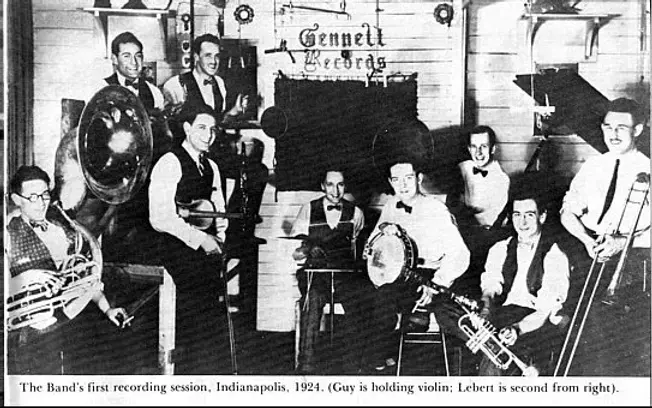
There is no doubt that Guy Lombardo and The Royal Canadians put London Ontario on the music map during the Big Band era.Guy (Gaetano Alberto) Lombardo was born on June 19, 1902, in London, Ontario, Canada, to Gaetano and Lena Lombardo. Lombardo senior, who had immigrated to Canada from Italy, worked as a tailor, and the family lived on a small house on Queens Avenue in the town of London Ontario. Guy was the eldest of seven children, five boys and two girls, born between 1902 and 1924 and took violin lessons from another Italian immigrant Prof. Venuta. In 1914 Guy with brothers Liebert (drums), Carmen (flute) and neighbour Kreitzer (piano) formed a quartet and played for the local Italian community. In 1920 they heard records of Paul Whitemans band and immediately became fascinated with the sound. They changed instruments to emulate it, Carmen to sax and Liebert to trumpet. By 1922 the group expanded to include more saxes, trumpets and trombone.In the spring of 1923 the Lombardo brothers were hired as the house band for the Hopkins Casino at Port Stanley on Lake Erie.
After the band started its second season at the Winter Gardens in London, the 21-year-old Guy decided that the group was wasting its time in Canada, and in November 1923 they traveled to Cleveland, Ohio, to make an attempt on the American market.In March of 1924 the Lombardos' band recorded several songs for the Gennett label. Their sound differed little from that of other white bands of the era, however, and the recordings sold poorly. They soon realized that changes were needed if the orchestra was going to survive. They began to develop their own brand of sweet music, focusing on melody over improvisation. Brother Carmen also helped create a distinct saxophone sound which gave them instant listener recognition and helped set them apart from all the other bands.
Their big break finally came in Chicago in 1927 when Guy paid radio station WBBM to broadcast a fifteen-minute segment of their performance at the Granada Cafe. By the end of *the night the ballroom was packed and the radio station had received so many calls that they extended the broadcast further into the evening.The musical team played at the Roosevelt Hotel in New York City from 1929 to 1959, and their New Year's Eve broadcasts (which continued with Lombardo until 1976 at the Waldorf Astoria) were a major part of New Year's celebrations across North America. Even after Lombardo's death, the band's New Year's specials continued for air two more years on CBSLombardo never forgot his friends in Ontario,, and when the Thames River, London Ontario flooded in 1937 he staged a benefit for flood victims in Detroit's Fox Theatre. The band opened this engagement with a rendition of Home Sweet Home, moving some in the audience to tears.

Bert Niosi
Bert Niosi was born on February 10, 1909, in London, Ontario. He studied with Prof. Pasquale Venuta, who also taught Guy, Carmen and Lebert Lombardo and many other muscians who became famous both domestically and internationally. When he was 12 years old, Bert was playing in a Chinese cafe. When he was 14 years old he was able to play sax, clarinet and flute and was touring with the Lombardo orchestra. He went with the Lombardos to the USA in 1923 for a successful six week stand in Cleveland and was prepared to move to Chicago with them but had to return home at his mothers insistance.
When he was 17, he formed his first orchestra with his two brothers Joseph (bass) and Johnny (drums) to play the Port Stanley summer resorts, where he stayed until 1931. That year, he also formed a 9 piece band which was booked into Toronto's Embassy Club. In 1932, he expanded and opened at the Palais Royal Toronto and remained resident there until 1950, becoming known as "Canada's King Of Swing". During this time the band also made summer trips to Port Stanley, Crystal Beach and The Brant Inn.
During the war he worked with conductor Eric Wild on the RCAF Recruitment Show and toured armed forces bases with his band
Bert proved to be an incredibly talented musician in that he could play the piano and almost any wind instrument which was offered to him, his favourite being the clarinet. Many of the top big band leaders such as Jimmy Dorsey, Gene Krupa and Glen Gray made him offers to play in their bands but Bert was more interested in his own group.
Niosi next embarked on a career with the CBC, first as a member 1952-9 of the Happy Gang, and then as music director of the TV series 'Four for the Show,' 'Cross-Canada Hit Parade,' and, 1965-76, 'The Tommy Hunter Show'. He continued to lead a dance band on occasion and returned to the Palais Royale for appearances as late as 1979.
On a CBC TV show in 1957 he played trumpet, trombone, alto saxophone and clarinet accompanied by his brothers . On an earlier occasion (1950) he played Mozart's Clarinet Quintet with the Solway String Quartet for CBC radio.
Bert Niosi died at Mississauga, Ont, 3 Aug 1987. One obituary stated 'He was likely listened to by more people who had more different interests than any other musician we have ever produced'.
Don Wright Orchestras
Don Wright was born in 1908 to James Wright, owner of the Wright Piano Company of Strathroy, Ontario. Don began studying cello at seven and trumpet at ten. With his brothers, Clark (Alto Sax), Ernest (Banjo), and William (Drums), he organized the Wright Brothers' Orchestra, which performed 1922 - 35 in Ontario dance halls. They played three summers 1922 - 1925 at Brights Grove Pavilion, and during this time Don was beginning to display his talents as arranger and finding out how to produce big band sounds with few instruments. During the summers of 1926 -1928 they then played the Port Elgin Casino. The band was in great demand in the winters and since the brothers were all attending the University of Western Ontario it became associated with that institution. From 1929 they toured, playing in Hamilton, Oshawa and Peterborough, and in 1930 were booked for the whole season at the Embassy a top-flight night club in Toronto. Futher engagements followed at the Brant Inn Burlington (1931-1932) and the Terrace Burlington (1932 - 1934). At the end of summer 1934 the group disbanded and each of the brothers went on to develop their own careers. Unfortunately there are no recordings of this band although they broadcast many times on local radio stations.
Don began his teaching career in 1934 at Sir Adam beck Collegiate in London teaching classics and history but with a mandate to promote music in the school. He also resumed his position of director of the UWO Band where his innovations included herald trumpets, tall girl drum major, and dance music played on the rugby field at intermissions.
His success with music at Beck resulted in him in 1940 becoming director of music for all London publlc schools, a position he held until !946. During this time he wrote many books on music and arranged for changing voices. These were also the war years. He and other volunteers (including Alf Tibbs,and Gayle Gordon) put on three shows a week with three troups at military bases throughout SW Ontario. Don planned the shows, wrote all the music and conducted the band during the performances (Don Wright reminisces about those days - see video -courtesy of Rogers TV)
.In 1946 Don gave up his teaching career to become manager of CFPL Radio in London. He developed a staff orchestra with music directed and arranged by Neil McKay, and a choir which became known as the Don Wright Chorus. Soon both became famous and were featured on regular coast-to-coast broadcasts which were also eventually carried in the USA.
Don Wright moved in 1957 to Toronto, where he formed the Don Wright Singers (1957-62) and composed commercials and scores for films and TV, including the CBC's 'Trail of '98' (1958) and 'Seaway to the World' (1959). He also composed Proudly We Praise (Thompson 1966), a tribute to Canada, which has been performed by school choirs across the country. As an educator he took a particular interest in the changing voice; his publications, choral and educational, included The Collegiate Choir (2 vols, Waterloo 1938, 1939), Youthful Voices (3 vols, Thompson 1945, 1949, 1954), Fun to Read Music (Thompson 1952), and Pre-teen Song Settings (Thompson 1961). His Fifty Years of Music with Don Wright, a photocopied collection of writings and music (20 vol, two cassettes) prepared in 1980, was distributed to Canadian universities and is also held at Library and Archives Canada.
In 1966 Don Wright began to establish music education university scholarships in his own name. He extended his philanthropic endeavours by giving millions of dollars to university music programs, notably to the University of Western Ontario, which renamed its music faculty after him in 2002.
Don died in 2006 at the age of 98.
Many thanks to Mary J Wright's book "Zestful Lives" for much of the information.


Doug Baker Orchestra
Doug Baker was born on January 17, 1919 in St Thomas, Ontario. He showed an early interest in music and took up the trombone as his instrument of choice. Musicians were in great demand at this time to cater to the dance craze that swept the land and Doug’s first engagements were with the Martyn Yorke Orchestra and then with the well-established Benny Palmer Band of St Thomas, where in addition to playing trombone he also sang with the aid of a megaphone.

After a while he was offered a position in the foremost band in London at that time, the Frank Crowley Band. Their playing venues included the Port Stanley Pavilion, Wonderland Gardens and Hotel London. This band had many talented players including Jack Fallon, later to become a bass player of world renown, and Archie Cunningham a sax player of enormous talent. Doug thrived amongst all these players and by the time he was 20 years old was lead trombone with the group. The band was not to last however, as Frank Crowley had health problems that became progressively worse, and after several very successful seasons it eventually broke up in 1940.
Doug Baker then took over, formed the band in his own style and called it the Doug Baker MerryMen. It quickly made a name for itself and became house band at Port Stanley Pavilion, playing six nights a week. These were the war years of course, and the Pavilion became the venue for many servicemen from Armed Forces bases in the St Thomas & London area - a place where they could meet other people,relax, forget their problems and. dance the night away.
As the war progressed Doug decided to play his part and volunteered for the Armed Forces. He was accepted, went through his basic training but was eventually discharged on medical grounds. He then reformed his band and resumed playing at the Stork Club in Port Stanley. The band was very successful and in great demand for the next 8 years. Many of his arrangements were written by musicians such as Eddie Graf, who was to become a renowned international arranger, and by Reg Saville who’s talents were cut short by an untimely death
After the war years audiences gradually declined and Doug dissolved his band in 1949. He continued to be an active musician and vocalist well in to the 1980s after which he took well deserved retirement. Doug Baker died in 2004 at the age of 85.
Many thanks to Doug’s daughter Bev Yurek for the information, photographs and audio.
Harry Wooster and the Orpheus Orchestra
London musician Ken Wooster (trombone) supplied this account from his family archives of how his father, Harry Wooster, started the Orpheus Orchestra.
"In the fall of 1920 Dick Cochrill, Reg Hodgins and Harry Wooster decided they should combine their talents and start an orchestra. No time was lost in debating the subject and they started to practice the very next night. Harry Wooster, by virtue of the fact that he played the lead instrument (the violin) was chosen leader with Reg Hodgins at the piano and Dick Cochrill at the drums. It was also decided to add a saxophone to the trio, as it was then the coming instrument for dance work so Mr Fred Davies was secured. Next came the selection of a name for the orchestra and after considering many different titles the word Orpheus was chosen as it was the name of a musician of ancient Greece and meant “the soul of music”. The first public performance was at a dance at Hyde Park on February 2, 1921 then followed several in London until the fall of that year. A series of dances was given to the orchestra so they had to increase their number to five adding Ed Ganney on the cornet. The orchestra by constant practice has developed into one of the best with unlimited number of musicians at its disposal".
By 1922 the orchestra was so successful that they added two more saxes and became capable of supplying a group of any size for any engagement.
In the same year the Orpheans also started broadcasting on radio station CJGC, owned and operated by the London Free Press, and drew a large audience in the surrounding area, so much so that their broadcasts became a regular event over the next few years. Fan mail came in regularly to CJGC from as far away as North Bay and Pembroke (see the postcards in the "Slideshow" below). The London Free Press of Tuesday December 19th 1922 lists the music program to be played by the Orpheus Orchestra in the radio broadcast that evening.
Throughout the twenties the orchestra flourished and became the top choice for the social Balls and events held in all the dance venues of the area. The family archives of Ken Wooster contain scrapbooks of London Free Press reviews of their performances, dance cards from their dances, letters of appreciation, and dance programs.

Personnel L to R : Milt Armstrong trombone: Cliff Lemigh trumpet: Cliff Axtell tuba: Harold Bentley trumpet: Phil Sawyer drums: Reg Ennis Banjo: Fred Hoffman sax: Reg Hodgins piano: Andy McCormick sax: Harry Wooster violin and Leader.


Archie Cunningham

Archie Cunningham began playing music professionally in London with the early Guy Lombardo Band. As an original member Archie stayed with the band during their first big move to Cleveland but he was forced to return home to London due to a severe case of appendicitis.
After he recovered Cunningham formed his own band called the Royal Marines, imitating the Lombardo sound but adding a jazzier touch with Archie's lead on saxophone. The Royal Marines were popular everywhere they played, from the local Springbank Pavilion in London to the Silver Slipper and the Palais Royal in Toronto, and the Brant Inn in Burlington. They were so successful that they made tours to the United States and also a six-month engagement at a resort hotel in Bermuda. The casino had no hesitation in billing Archie Cunningham and the Royal Marines as the best band in Canada.
The band even had an opportunity to tour in Britain. However, the tour had to be abandoned because the band members believed that such a venture was too risky.
After the group disbanded in the late 30s, Archie Cunningham continued his career playing sax and clarinet with such local bandleaders as Alf Tibbs, Frank Crowley, and also toured the service bases during WW2 with Don Wright’s concert troupe.
After the war Archie continued to play with local groups until he retired at the age of 84. Archie died in 1988.
To honour Archie’s life-long love of music, his son, UWO alumnus Barry Cunningham (BSc’57), has established, in perpetuity, the Archie E. Cunningham Memorial Continuing Entrance Awards at the Don Wright Faculty of Music. The donation, endowed at Foundation Western, will support three students with $5,000 each year for the four years of their studies. Students eligible for the award must demonstrate financial need.


Jack Pudney
The Pudney family owned and operated a music store at Dundas and Waterloo Street in London and Jack's band was formed in the 1920s from the many musicians who visited the store. He quickly became very popular and played many of the large dancehalls in the area.
When the Port Stanley Pavilion opened in 1926 Jack was anxious to get the band playing there. He eventually achieved his wish but with some personnel changes as some of the original members did not want to be tied down every night of the week. Due to pressure of other work Jack did not always front the band and on these occasions Mickey McDougall would take the baton.
He became very popular at Port Stanley and the Casino heavily promoted the band. Local radio stations also broadcast his dances from the Casino. The reputation of the band spread and It became so highly regarded that Jack Pudney signed contracts for a USA tour and also for engagements at supper clubs in London England.
After a few seasons the strain of playing most nights of the week took its toll and the band dissolved
The folllowing displays are courtesy of Teresa Margaret King, granddaughter of Eddie King, banjo player with Jack Pudneys band. All the images are from her extensive archives.


Bubs Jamieson Orchestra
Bubs Jamieson was born in London Ontario on December 6, 1920 and took piano lessons at an early age. He attended Central Collegiate at the same time as Reg Saville (saxes) and Hugh McKenzie, (drums), who were also to become well known in the music business. It wasn't long before a group of them got together to make music, with Reg Saville writing the arrangements.
Bubs next played at Ipperwash Casino with Tim Freeborn's band during 1938 and 1939, at which time Freeborn decided to step down. Bubs took over the group and renamed it the Bubs Jamieson Orchestra. The new group played Ipperwash Casino until 1940 and also played the London YMCA winter dances on Saturday nights after Alf Tibbs. They also played engagements at Goderich Pavilion for two years, at Wonderland Gardens, and as far afield as Windsor,
When WW2 broke out Jamison joined the Armed Forces in 1942 and served with the Middlesex and Huron Regiment. He was married at Camp Borden, spent time at Three Rivers and played in the army band of the time with another local musician Ken Wooster. He went overseas as a lieutenant, was captured in Italy and held as a prisoner of war.
He came back to Canada in January 1946 and thereafter devoted his time to his career in sales, which led eventually to becoming vice president of Harvey Woods.

Saxes: Vic Lobasky, Frank Serratore, Si Plater, Russ Mills Trumpets: Eric Cosgrove, Don Hopkins
Trombone: Ken Wooster
Rhthym: Doug Hook Guitar; Ross Willis drums; Bubs Jamieson piano. Vocals; Carolyn Wells
Elmer (Al) Keen Orchestra
Elmer Keen was a pupil of Professor Venuta and studied all the reed instrunents with him. He then played with several leading orchestras in the USA before returning to London in the thirties when he formed the Al Keen Orchestra. They played at Grand Bend's Lakeview Casino, Stork Club Port Stanley, Wonderland Gardens and Hotel London.
When WW2 broke out Elmer enlisted in the Canadian Army and was posted overseas to the UK where he became heavily involved with the music and entertainment branch of the armed forces.
Details of Elmer Keen's activities after WW2 are unknown at this time, please reach out if you know any additional information.

Mickey McDougall Orchestra
Mickey McDougall was said to be a self-taught musician who in his early days played mostly by ear mastering a number of instruments including alto sax, clarinet, organ and violin.
He joined the Jack Pudney Band in the early 30s, a band that quickly became very successful and was soon working seven nights a week at Port Stanley Pavilion. This proved to be a heavy schedule for Jack, who had other business interests to look after besides the band. Jack realised that Mickey had the personality to front the band so he appointed him interim leader and announcer during the week. This allowed Jack to only show up at weekends. However the strain of playing seven nights a week became too much for the band and it eventually broke up.
Mickey McDougall then went on to form his own group and his prior experience leading the Putney Band served him well. His musicality and personality were right for the times and soon made his band very popular over all South-Western Ontario. In 1935 the band was chosen to play for the opening of “Canada's most beautiful dance rendezvous” - Wonderland Gardens in London Ont. Mickey played several seasons at Wonderland and made numerous broadcasts over radio station CFPL. The band also played the large clubs such as the Stork Club in Port Stanley and Silver Slipper, Embassy and Palais Royal in Toronto.
The band eventually dissolved, but Mickey maintained his life long interest in music. In the 1950s he became a member of Lloyd Wrights Radio Rangers and perfected his sparkling clarinet technique with this group. He then spent many years with the Dixieland group called “The Aggregation” playing clarinet.
Ted Palmer Orchestra
Ted Palmer was born in London Ontario on March 27th 1907. His music career began when he took lessons on sax and clarinet from Professor Venuta. Ted must have been a very apt and talented pupil since in later years Professor Venuta would recommend him as a teacher of sax and clarinet. Venuta also included the names of his most famous pupils on his own personal letterhead - the Lombardo Brothers, Bert Niosi and Ted Palmer.
Ted formed his own group in 1932 and the band rehearsed for a full year before taking any jobs, the first of which was at Ipperwash Beach. The casino there has long since gone. The next engagement was at the Brant Inn, Burlington Ontario, which lasted for a full year - normally the Inn closed during the winter months. Ted Palmer left the band during this engagement due to a problem with management and Gayle Gordon took it over.
Ted Palmer then went on to create a series of music stores in London, St Thomas and Sarnia - the London one was located at 110 Dundas St according to the 1938 directory of the city.
In the 1940's he joined the London education system and taught music in the public system. He died in 1965 and is buried in Sarnia

Alf Tibbs Orchestra

Alf Tibbs was born in London in 1904. When he was 12 years old he got a job with the Heintzman piano Company delivering pianos, and in so doing quickly learned to play the piano. He became an excellent pianist and with his natural music talent became proficient on several other instruments. In his teen years, he practised and played with Guy Lombardo's early band and planned to leave with the band when it went to the USA to find fame and fortune. Unfortunately his grandmother discovered his plans and refused to let him go. He played with local groups but then decided to have his own band and be his own conductor.
Alf called his original Orchestra “Alf Tibbs and the Georgians” and one of his first jobs was at the opening of Hotel London in 1927. Joan (Tibbs) Tanner, Alf’s daughter, still has all the original band record books and they show the engagements the band played. They played for many years at the Masonic Hall on Queens Avenue in London, and during the 30s played at most of the society functions and popular dances in the area particularly at Hotel London.
It was a completely professional band, well turned out and very proficient. They also played the resorts of Lake Huron and Lake Erie during the summer and for many years was the house band at the Stork Club, Port Stanley, playing seven nights a week all summer long. Dance cards were still popular in the 30s and examples of their use at Alf Tibbs dances can be found in the photographic slideshow.
During WW2 Alf Tibbs organised an All-Star Variety show, which performed for servicemen stationed at bases throughout South-western Ontario. Alf was MC for the show and Don Wright directed the band. The show featured various acts including a magician, comedian, dancers, Gale Gordon as solo violinist as well as his full Orhestra, cowgirls and others. Singers were Ginny Mitchell and Gayle Gordon.
After the war Alf Tibbs continued to play at resorts and functions throughout SW Ontario. He died in 1978.
Unfortunately no audio of the band can be traced at this time. If you can help please contact us.
Joe Maycock Orchestra (Gayle Gordon)

Joe Maycock was born in Manchester in England on March 12, 1911 and came to Canada at the age of four where he took up residence in London Ontario. He attended school in London and at an early age learnt to play the violin at Sacred Heart Conservatory Of Music.. He then played sax in London Collegiate and at the age of 18 played first violin in the Symphony Orchestra of London.
This was the time of dance bands and their recordings and Joe turned to popular music to form his first band in the early 30s, playing the summer resorts of Southern Ontario. He then moved to Toronto to play at the Silver Slipper Club and at the same time changed his name to Gayle Gordon to make it sound more attractive and sophisticated. He was an instant hit and by 1934, was broadcasting regularly on radio station CFRB from Toronto.
Further engagements followed in Montréal at Stadium Ballroom where he broadcast nightly over CKSC, then back to Toronto and then to the famed Brant Inn in Burlington, where they gave nightly broadcasts over CHML Hamilton.
In the late 30s, Gayle Gordon disbanded his orchestra, moved back to London, took up a career of lithographer at Wright Lithographing Co., and joined Alf Tibbs Orchestra as vocalist, violinist and tenor sax player. In World War II he reformed his band “Gayle Gordon and His Orchestra, 14 Men And A Girl” and played in a review organised by Alf Tibbs that entertained servicemen throughout southern Ontario. Alf Tibbs was MC of the show and Don Wright conducted the Tibbs band.
After the war he joined Neil Mackay’s CFPL Orchestra and was featured on CFPL’s “Invitation From Dominion” London's first coast-to-coast network show. Gayle Gordon became very popular as a vocalist, and reviewers stated that he was fast challenging the popularity of Sinatra and Crosby in Canada. When he made records in Toronto one columnist stated “He's one of those rare crooners who started playing in the Symphony orchestra and can handle three or four instruments as well as he warbles.
Gayle Gordon Band

Johnny Brennan Orchestra

Like many of his contemporaries Johnny Brennan received his early music training with the London Police Boys Band. He found that he had a natural talent for music and singing, and made rapid progress with the trombone, his chosen instrument.
So much so that by 1948 he formed his own band and played for the summer crowds at Port Elgin Casino and then returned the following year for another season. Johnny led the ensemble on trombone and handled the vocals.
From 1950 -1951 he was booked at Wonderland Gardens in London, becoming a very popular attraction playing four nights a week for dancing. The band followed this by appearing three nights a week at Ipperwash Casino for the next two summer seasons.
In 1955 Johnny embarked on a major challenge - a hands-on building of his own dance hall just south of Lambeth, with the help of his partner Bruce Cowin, which they called the "401 Plaza". It was an immediate sucess and people from London and surrounding area thronged to the new venue to dance to the band. The 401's popularity continued right through the 50's and 60's.
In 1971 Johnny decided to retire to pursue other interests and sold his book to Ron Shadbolt who took over as house band.

Downs Family Orchestras
All siblings of the Downs family took music lessons at Sacred Heart Convent when they were young, and as they grew older became a musical dynasty in London. The three brothers all became bandleaders and were a major part of the London dance scene for the last half of the 20th century. Johnny, Bobby and Don Downs all led their own bands and bookings were made through their central office at the Latin Quarter restaurant. Check out their pages for more details.

Bobby Downs Orchestra
Bobby Downs was born 1925 in London Ontario and in common with all his siblings took music lessons at an early age on piano at Sacred Heart Convent. He soon graduated to trumpet and by the age of 16 led his own group as an intermission band at London Arena when touring American big bands were playing.
The band was very successful and in the late forties and fifties played engagements at Grand Bend (every summer for three years), Rondeau Park, Ipperwash Casino, Port Elgin Pavilion, Goderich Casino, Midland, Port Stanley and other lake resorts.
When these resorts declined in popularity he continued playing for dances weddings, company functions, etc. and all bookings were handled from the Downs family offices at the Latin Quater Restaurant. He eventually disbanded in the early nineties.
Bobby Downs died in June 2007 at the age of 82.

Personnel
Saxes: Charlie Watt, Joe Lewicki, Hugh Nichols, Ron Stone
Trumpets: Len Smith, Bob Ciamaga, Dick Lane
Trombones: ?,?,?,
Don Downs Orchestra
In common with all his siblings, Don Downs took music lessons at an early age on piano at Sacred Heart Convent in London Ontario. He then adapted the saxes as his instruments and eventually became part of the Downs Family Entertainment organization operating from the Latin Quarter restaurant in London. Don and brothers Bobby and Johnny all led orchestras designed for the type of engagement being fulfilled.
Don's specialty was to provide small groups for weddings and private functions.
Personnel
Saxes: Don Downs, Joe Lewicki, Peter Senese.
Trumpet: Len Smith
Drums: Don Jolley, Piano: Don Morris


Graydon (Hoppy) Hopkins Orchestra
The 1948 London Musicians Ball program described the "Hoppy" Hopkins Orchestra as follows:
One of London's newest bands is Graydon Hopkins. Hoppy is a familiar face on and off the bandstand in and around London. His singing and size have made him a lot of friends around town.
The band boasts the only five-way sax section in town and first reports say the other sections are living up to the already fine standard of music in London
Sweet vocals are handled by Hoppy himself while the scat side is taken care of by Frank Serratore.
Personnel
Saxes: Hoppy Hopkins, Ernie Clements, Frank Serratore, Vic Serratore, Tony Caminiti.
Trumpets: Frank Williams, Walt Nozen, Eddie Assaf.
Rhthym: Benny Dennomme - Piano: Ed Bergin - Bass: Dick Stookes - Drums
Len Langley Orchestra
Len Langley was born in St Thomas and played trumpet with local bands. When WW2 came along he joined up and served overseas.
When he returned home again at the end of the war he resumed his musical activities and formed a band known as "The Stardusters". The band was active in the London-St Thomas area and in the mid fifties became the house band at the Seven Dwarfs, London, playing for the after hours crowd on Saturday night.
A regular Saturday night engagement at Wonderland Gardens followed, and the band became known as the "Len Langley Orchestra" when Len added more musicians. At the same time Johnny Downs was playing at the Stork Club in Port Stanley. By mutual agreement in 1960 the two bands switched venues and the Len Langley Orchestra held forth at the Stork Club for almost ten years. During that time there was lots of work for live bands and Len took the group on Friday nights to many out-of-town engagements.
The band continued to play through the early seventies, but times were changing and the demand for big bands became less and less. Len eventually disbanded his orchestra and donated his music library to London Musicians Association.
In his later years Len lived in Port Stanley and spent the winters in Florida where he kept active musically playing and singing in small groups.
Many thanks to ex-Langley trumpet player Dick Butterwick for the commentary, audio and photographs.


London Life Troupers
London Life organized "The London Life Troupers Variety Show" in September 1940 to help provide entertainment for men in the Armed Forces. Troupers would travel to one of the many training camps of Western Ontario to present their show to young service men, many of them from the United Kingdom as members of the Commonwealth training plan, and the others Canadians who might also be far from home.
London Life paid all expenses. The format chosen was that of a concert party. There were vocalists - girl soloists, trios and quartets and male soloists and quartets. There were also three dance lines of 12 girls each, notable for their beautiful costumes and precise performances. An 11 piece orchestra led by Don Wright provided all the music accompaniment and solo performances for the show. Altogether 154 London Lifers were enrolled. Don Wright talks about his experiences during these years in the following video clip ( courtesy Rogers TV).
All members of the troupe were volunteers who give their time and talent as a war activity. The orchestra was composed of members of the local Musicians Union who graciously contributed their services for all shows. The troupers presented their show eighty-five times in four seasons, from 1940 to 1944. It was a busy time for all. Not only for the traveling and performances, but also for rehearsing the dance routines and specialty acts and they became noted for the fast pace of their show and the precision of their dance routines.
Back Row: Herb Stratton bass: Harry Reed tenor sax: Dick Burch alto sax: Jean Hall piano: Tommy Brooks alto sax: Jack (Scotty) McLaughlin tenor sax: Ross Willis drums.
Front Row: Ken Wooster trombone: Walt Brandie trumpet: Don Wright Leader & lead trumpet: Len Weeks trumpet.
Also played but not appearing in photo - George Tingey trumpet: Stan Coups trombone:


Neil McKay Orchestras

Neil McKay was born in Vancouver and came to London when he was eight years old. in 1940 he wrote arrangements for his own swing band and then played his first professional engagement at the Kincardine Beach Pavilion in the summer of 1941 . The next year he appeared at the Goderich Pavilion during the summer, and the band stayed together all in one house for the whole season. The band became very successful and were much in demand in the area, playing at London's most popular venues, London Arena and Springbank Pavilion. By the spring of 1944 the band had grown to 14 members and was house band at London Arena.
In 1944. Neil and other band members joined the Armed Forces. Neil played and arranged for Navy bands and served on the aircraft carrier “Warrior”. He also played at the historic Quebec Conference hosted by Canada where Winston Churchill and Franklin D Roosevelt met for discussions.
After the war he joined Johnny Downs orchestra and arranged much of the music the band played in the summer resorts and local dance halls that year . In the summer of 1946, he joined CFPL to produce a new radio program called “The Don Harding Show” a fifteen minute musical show featuring the Neil McKay Octet and showcasing Neil’s vocal and instrumental arrangements – see examples below in “Audio” section. The CBC broadcast the show coast-to-coast on the entire Trans-Canada Network.
In 1947 Neil and CFPL station manager Don Wright organised a studio big band, called “CFPL All Stars” to broadcast a weekly program "Invitation From Dominion" on the entire coast-to-coast CBC network from London. Vocalists joined the group – Ginny Mitchell and Joe Maycroft ( stage name Gayle Gordon) - and London Arena became the venue for the Saturday night broadcasts by the CBC.
From 1948 – 1954 Neil wrote for many music disciplines. During this time CFPL Radio produced a program called "Silverwood Serenade" and for this show Neil added a five piece string section and French horn to the studio band. The show had a thirteen week run and Neil wrote about 90 arrangements in all - in later years he was to say that this was the hardest he ever worked!. He fronted a small group in another CFPL show "Search For Songs" - amateur songwriters sent in original songs and listeners chose the winner each week. He continued to lead his band and play in the summer resorts and dance halls in the London area, keeping the front row of five swww.neilmckaymusic.com/catalog.html#CHMusic axes intact so that the Glen Miller sound would be maintained. He also found time to play clarinet with London’s Civic Orchestra.
Neil then left London for Rochester, NY to earn M.A. and Ph.D. degrees in composition at the Eastman School of Music. His master's thesis, "Festival Concertino", won first prize in the Ottawa Symphony competition for Canadian composers and was premiered in Canada's capitol city. His doctoral dissertation, "Symphony No.1", was published by E.F. Kalmus and is widely performed in the U.S. and Canada.
From 1957 – 1964 he taught at the University of Wisconsin-Superior then joined the University of Hawai'i, retiring from the latter in 1987 as Professor Emeritus. During this time he composed many orchestral works, his music influenced by the sounds and concepts of music of the Pacific Basin, and jazz. A full list of his compositions can be found here
In retirement Neil McKay led a composite life of composing, travel and golf.
Neil McKay died December 8th 2016.

Scotty McLachlan Orchestra
Scotty McLachlan formed his orchestra in 1945 and for three straight seasons played at the Masonic Temple in London where his dance style attracted considerable attention.
He also played the Lake Huron resorts at Goderich and Grand Bend and appeared in the "Parade Of Bands" at the 1948 London Musicians Ball. Further details are not known.

In 1948 Eric Corgrove, Joe Rogolino (trumpets) and Dalton Walpole (piano) played with the group.
Russ Mills Orchestra
When WW2 ended in 1945 Russ Mills re-assembled the old Bob Wybrow band and took over as leader. In the fall of 1945 Hotel London engaged the band and they continued to play there for the remainder of 1945 and 1946. The band was very successful and its members were the leading local big band musicians of the time.
The band ended however in 1948 when Russ Mills was transferred to work in Sarnia.

Personnel
Saxes: John Zadorsky, Joe George, Frank Serratore, Russ Mills (Leader)
Brass: Ken Wooster, Eric Cosgrove, George Tingey, Eric Hahn
Rhthym: Dick Stocks - Drums, Doug Hook - Bass, Archie Poulton - Piano
Ted Pudney Orchestras

Jacqueline Pudney provided this biography of her late husband Ted Pudney together with audio clips and photographs from her archives
Ted Pudney had two passions in life, music and horses, both developed from an early age under the watchful eye of his uncle Jack Pudney, a prominent band leader in the London area. Ted’s family owned a chain of furniture stores in South Western Ontario until the depression of the thirties when they were reduced to the antiques store located on the north side of Dundas Street just east of Waterloo Street. If you look at the top of the façade you can still see the date and the Pudney name engraved into the building. In their heyday they also had a cottage at Port Stanley where Ted spent many a summer. As a teenager he played competitive tennis and did well in boxing. He took violin lessons and as a summer job collected the “jitney” dance tickets for his uncle’s band, no doubt developing the desire to front a band of his own one day. Jack Pudney also introduced Ted to the world of the London Hunt Club. Ted along with one other were the only two children allowed to ride to hounds with the Hunt Club in those days.
Ted’s musical abilities grew to encompass most of the wind instruments, clarinet, flute, saxophone, trombone and trumpet with enough piano to write full band arrangements in both swing and Lombardo styles. Ted, as a young man, joined the highly successful Benny Palmer Band where he started to perfect the “Lombardo” saxophone sound so unique to Carmen Lombardo. After the sad death of Benny Palmer in 1942 Ted started his own “Ted Pudney and His Music” band. This was to be a swing band styled after Artie Shaw and Benny Goodman combining Shaw’s flair and style with Goodman’s technique and sound. His brother Ken Pudney acted as business manager and Joan McMaster, Ken’s future wife became one of the band’s vocalists. Leading the band on clarinet Ted could play to perfection all the well known solos and enjoyed adding the showmanship. In one opening number he would start by jumping from the upper tier of the band to the floor in front of the band , turning and raising the clarinet in one motion to start playing the clarinet introduction! Those were the days of local live entertainment done with style in a big way.
In the summer of 1946 the band broke all records at the Port Dover Summer Gardens and for the next two years played Wonderland Gardens in London. The management of Wonderland Gardens presented Ted with a conductor’s baton inscribed “To Ted in Appreciation Wonderland 1947- “ there was no “ending” date on the inscription!
The Second World War came along and Ted signed up to do his duty as a rifleman with the Army Service Corp. His army pay book said “he can hit anything he can see”. He left his young daughter Margaret and his first wife Margarite (“Lovey”) to await his return. When the war was over in Europe the army found that Ted besides being a crack shot was also a musician. With thousands of soldiers waiting to be repatriated there was a need for entertainment so Ted was “volunteered” into the Robert Farnham Army Orchestra. He also played in other army dance bands. Eventually he was returned to Canada. Before resuming his “civvy street” life he took a group of army musicians to Radio City Music Hall for a talent competition which they won.
Back into civilian life Ted started his Ted Pudney dance band once again playing all the old haunts to crowds glad to listen, dance and enjoy themselves once more. Time can never seem to stand still and eventually Rock and Roll came along and the days of the Big Bands were numbered. Their bigger size and costs were replaced by smaller groups and eventually the “canned” sound of the disc jockey. The big bands were to recede into distant golden memories.
Ted then turned to another of his many talents – salesmanship, becoming Used Car Manager for London Motor Products. By now he was married for the second time, unfortunately again this was not meant to last. However this is when he bought the 55 acre property north of London where they could keep their horses. They both hunted with the London Hunt Club and Ted enjoyed competing in the show jumping ring in events sponsored by the London Hunt Club. This he did with his usual success. Disastrously one night driving home he crashed his car into a cement bridge abutment at Birr. Lucky to survive at all he nevertheless spent much time hospitalized and in a long depressing recovery. He returned to the car business but was still bothered with ill health. At this time his second marriage was dissolved.
In 1960 while teaching some people to ride he met his third and last wife Jacqueline Talbot. Although there was a great difference in their ages the marriage was to be a lasting and loving one. Both he and Jacqueline continued with the horses and Ted now returned to his music although part time. The Chateau Gai Orchestra was having problems and asked Ted for help. Ted had a chance to return to his first musical love the sounds of the Guy Lombardo Band. He wrote a book of arrangements in the Lombardo style, took the place Carmen would have played and rehearsed the Band. The band played weekend engagements and Ted’s enthusiasm had returned. After a few years Ted again put together a band of his own “The Canadians” with Graydon “Hoppy” Hopkins acting as business manager as well as playing in the sax section. Again the band played weekend engagements . There were many late nights that turned to early mornings with Ted jamming with his fellow musicians. During this time however his doctor advised that he should not continue with the car business because of continuing trouble with a severe duodenal ulcer. In those days it was thought to be brought on by stress. So Ted again changed his profession. In trying to find something not “stressful” he turned to his other passion, horses, and decided to become a farrier, shoeing horses. Being the ultimate perfectionist he again was not satisfied with the average but became known for his ability to make shoes and help horses that had problems with feet or legs. He was much sought after and welcomed by many of London’s horse owners. After many years at this profession and after another car accident Ted’s health began to fail and he died in 1980 after a long struggle with emphysema and congestive heart failure. He is buried in the Prospect Hill Cemetery within sight of the country property he loved so much. His wife Jacqueline, now a professional artist, still resides there running her “Valley View B&B” and now working with Ted’s favourite breed of dog – the German Shepherd, competing in the Schutzhund Sport.
One of Ted’s fondest memories that he related to Jacqueline was of rehearsing his band at the Stork Club where Louis Armstrong had been brought in to play. In those days you had to have a Canadian band playing opposite the ”foreign” band . Ted was rehearsing and glancing out at the dance floor caught sight of Louis with a chair turned backwards and resting his chin on his hands on the back of the chair. He finished the number and came over to Louis asking him what he thought. Louis said he had been walking by outside, had heard the music and thought if was “The Man” playing by which he meant the Guy Lombardo band. Coming from such a great musician with such a good ear Ted felt he could not have received a finer endorsement of his success in producing the Lombardo sound. Guy Lombardo was Louis’ favourite band - as Louis put it “they play the mel-o-dy”.
Sometimes now on a quiet night as the wind blows through the trees at Valley View you can almost hear the faint strains of a clarinet solo or some sweet Lombardo melody, old memories never die!


Lionel Thornton & The Casa Royal Orchestra
The Casa Royal Orchestra was originally formed in Strathroy in the 1930s and it was in 1942 that Lionel Thornton joined them. At that time he was vocalist and playing bass with the Benny Palmer band in St Thomas, but when the band dissolved he moved over to the Casa Royal Orchestra and became leader in 1943.
During the remaining WW2 years they played as summer house band at the Goderich Pavilion, and in the post war years played in all the major ballrooms in the London area and SW Ontario including the Stork Club, Stratford Casino, Woodstock's Southside Ballroom, Rondeau Park Pavilion, Grand Bend, Wonderland Gardens and Port Dover. For 26 years they played the London Hunt Club New years Eve Ball and had repeat engagements at Sunningdale and IODE Balls. They also became a regular at Wonderland Gardens.

Personnel:
Jim Davey - Trombone
Bill Davies, Dave Bentley - Trumpets
Frank Serratore, George Walker, Russ Lansing, Phil Sparling - Saxes
Lionel Thornton - Bass, Bill Sutton - Drums, Roy Allison, Marilyn Thomas - Vocals


Frank Traher & His Orchestra
Frank Traher formed his band in 1947 and at the time was the only trombone player to front a band in London. A review of the time states that "Frank concentrates on good danceable tempos and his music is on the sweet syle, probably as a result of his many years with the Casa Royal Orchestra"
The orchestra played for the Annual London Musicians Ball at the London Arena in 1948 but the fate of the band after that is not known. Many years later his son Tyrone Traher was to organise and manage London's Big Band Festivals.

Personnel
Left to Right: Fred Bernado - trumpet; Bob Jeffery - trumpet; Joe Badalato - piano; Johnny Pleiter - Sax; Frank Traher - trombone & Leader; Les Glennie - drums; Wally Hawthorne - sax; Jock Thompson - sax.
Bob Wybrow Orchestra
Bob Wybrow took over the Bubs Jamieson Orchestra when Bubs joined the Canadian Armed Forces in 1942. They played at the Stork Club Port Stanley for two summers and also London Arena in the fall of 1942 and made several broadcasts from that location.
However as more band members joined the armed forces it became neccessary to disband in late 1943. The band had consisted of top musicians of the day and one, Eddie Graf, went on to become an international arranger for big bands and other musical groups. Bob Wybrow moved to Niagara Falls in 1946 where he led bands for many more years. Ater the war the band reassembled under the direction of Russ Mills.

Personnel
Saxes: Russ Mills, Howard Parsons, Norm Greenslade, Eddie Graf Trumpets: Ken Lane, ?, George Tingey Trombone: Les Douglas
Rhthym: Ross Willis - Drums, Doug Hook - Bass, Bob Wybrow - Piano. Vocalist : Doris Martin
Gord Cooper Orchestra

Gord Cooper was born in St John New Brunswick, on April 5, 1931, when his father was in the Army stationed in that area. His mother died nine days later and an aunt brought all the children back to London Ontario to raise them with the rest of the relatives.
Gord started piano lessons, advanced very quickly and was much in demand for school concerts. He then joined the London Police Boys Band in his early teens and played with them until he decided to get married at the age of 21. During his time in the LPBB he became fascinated with all the instruments in the band. This fascination was to last all his life and although his principle instruments were piano, tenor sax and euphonium he became proficient on a wide variety of other brass, reeds and keyboards. Shortly after leaving the Police Band Gord organised his own group – “The Gord Cooper Orchestra” and played for dances throughout the fifties and sixties.
Later as the era of the dance bands declined he joined the Mocha Temple Shrine Band, the London Pops band, and others when the opportunity arose. For several years right up to the present his band has played the New Years Dance at Parkwood Hospital for the veterans. He also played euphonium numerous times in Salvation Army bands when they needed him.
Gord Cooper died February 28th 2008 after a long battle with cancer, but before he died he was the inspiring force behind organising the first reunion of the London Police Boys Band which took place April 18th – 20th 2008.
Benny Goodfellow & The Londonaires

Personnel
Saxes : Joe ?, Joe Lewicki, John Harvey, Ron Shadbolt.
Trumpet : Benny Goodfellow
Rhthym : Bass John Carrothers, Piano Bill Mason, Drums Ed Cowie
Singer : Doris Goodfellow
Bob Martin Orchestras

Bob Martin started playing trumpet at the age of ten. His first teacher in London was James Allan Ford who later became conductor of well-known concert bands in the area. After a few years "Jimmy" suggested that they both study with Ray McConnell in Detroit.
Bob's travels throughout the States, afforded him the occasional opportunity to take lessons with many renowned players when he was visiting their respective cities e.g. James Tamburini, Detroit Symphony, Armando Ghitalla, Boston Symphony and many others. One of the highlights of these chance opportunities was to spend time with Mexico's trumpet virtuoso, Raphael Mendez. It was Mendez who suggested James Stamp as a teacher for advanced studies. Stamp was residing in Hollywood, California at the time.
James Stamp was considered the top trumpet teacher in L. A. and it seems that every player of consequence had studied with him at one time or another. Players from both the classical and Jazz-Pop field came to Stamp. Bob soon realized that what James Stamp espoused in his teachings were playing principles that Stamp had learned from his teacher Max Schlossberg. (Schlossberg to this day is considered the foremost trumpet guru of all time)
Over many professional years Bob had the occasion to back many recording artists e.g. Sammy Davis Jr., Liza Minnelli , Della Reese, Bob Hope and countless others. One of the early highlights of his professional career was to become a member of the Strategic Air Command Concert Band in Omaha, Nebraska. That band also had a Jazz Ensemble which was led by Tommy Newsome who later became well known as a member of the Doc Severinsen Tonight Show Orchestra.
Some time later, Bob played for the Stratford Shakespearean Festival Theatre in Stratford, Ontario. His other theatre experiences included Theatre London, (Berthold Carriere conductor) as well as the Kitchener Regional Theatre playing Broadway shows. It was at the Stratford Festival Theatre that Bob became the recipient of the Tony Guthrie award. It was an award given to actors, musicians or craftsmen in recognition of their contribution to "theatre." Bob Comber, another London native, was the very first musician to receive this award at Stratford and Martin was the second such recipient. Bob Comber later went on to become principal percussionist with the National Ballet of Canada Orchestra.
In 1972 Canadian Music Associates was established with fellow musician Gary Morton. (see Musician's page Bob Martin) The Music School offered private instruction on various instruments and courses in Big Band interpretation and performance. Scholarships were available to students who wished to attend Berklee School of Music in Boston, Mass. (hear sound file under Audio Section below of the C. M. A. Student band with Bob Martin soloing on trumpet).
For many years there was a wide variety of professional engagements available to London musicians e.g. London's Western Fair Grandstand, backing performers of every description including the Lee Castle Circus and the Garden Brother's Circus. Bob was not only a player for these shows but also contracted the musicians. In addition he conducted the orchestra when the occasion demanded.
Ice Capades was another professional opportunity for Bob and local musicians. These shows were yearly events that lasted over 15 years. The London Western Fair Grandstand shows and Ice Capades were challenging and interesting presentations for London musicians. Bob also had the opportunity to play the Ice Capades in Kitchener and Toronto during these years.
Playing on Cruise Ships was an interesting era for Bob, which took him through the Panama Canal some 20 times, seeing several countries in Central America, also circling South America about a dozen times (including the Falkland Islands) sailing to Hawaii and stopping off at numerous exotic islands in the beautiful south Pacific. One of his favourite trips was sailing up and down the coast of Alaska.
Bob's first published book was "Jazz Duets for Trumpet" which was distributed by Berklee Press, Berklee School of Music.(Boston, Mass) Other publications (text books) include "Dynamic Polarity" aka "Strato Chops for Trumpet - Brass" (Development Concepts In Building Professional “Chops” For Trumpet - Brass) distributed by Warburton Music Products, Oviedo Florida.
Bob Martin's extensive professional career encompassed many venues in Canada and the United States. As it turned out his career presented a wide variety of stylistic requirements from classical to the Jazz-Pop idiom. Bob is still an active participant in the music scene of London and Toronto.


The WindMiller Band

The WindMiller Band started its new era in 2013 with a repertoire emphasizing swing music of the big band era. The group’s name accentuates and emphasizes its enthusiasm for the Glen Miller sound that features a clarinet lead. Also captured in its name is the band’s long time association with the Dutch Canadian Society in London.
The current band comprises five reed players, eight brass section members and a rhythm section of three. The band’s leader is saxophonist, Ken McLagan. He is a music graduate of Western University and well known among the city’s musician community. As the leader of the WindMiller Band, he is committed to the band playing Big Band arrangements, Latin favorites and show tune medleys.
Performing is the priority for the WindMiller Band. The band’s objective is to provide local and regional audiences with well-played tunes reminiscent of the time when swing was king. That is, music reminiscent of that enjoyed in the pre and post World War II era at places such as the Stork Club in Port Stanley or London’s Wonderland Gardens.
The band’s book features arrangements by the swing era greats – Art Dedrick, Johnny Warrington, Glenn Osser, Sammy Nestico and Dave Wolpe - as well as local arrangers, John Montgomery and John Tenkate. Tenkate, along with Hank Uitvlucht before him, lead the band in its earlier incarnation as the Dykehoppers.
The Windmiller Band sadly disbanded in 2017.
Frank Crowley Band
Frank Crowley, whose career started at De La Salle High School in London began his professional life by playing in Archie Cunningham's Royal Marines in the early thirties. He then must have made the journey to play in England since Jack Fallon in his autobiography "From The Top" writes
"Frank Crowley had recently returned from London England where he had been playing at the Kit Kat club with the Canadian band led by Billy Bissett . The trio for the new club was Frank on Alto, Jack Burrows on piano and me on base, the gig was super. Frank was a real charmer with a great personality, which made the date a pleasure. Being the new boy he made it very easy for me. Jack Burrows also a real gentleman was very quiet and just got on with the job.
The following spring Franks band was booked for the summer season at the new open-air dance spot at Port Stanley on Lake Erie. The Trio were augmented to a 10 piece band. The new band was quite successful and between seasons we had bookings for a two weeks spot, including a broadcast, at the Palais Royal, Sunnyside, Toronto, followed by one nighters at the Jubilee Pavilion Oshawa, and Mohawk Park, Brantford. The winter season we played the Masonic Temple in London and the following summer, we opened at Springbank Pavilion amusement park which was located on Springbank Drive, just outside the village of Byron 7 miles west of London.
This was a big success, the place was packed six nights a week. Jitney dancing was in operation. This is the type of dancing, where the man has to pay for every dance he has. This was followed by a winter season for Herbert Paine at Rye’s Pavilion on the Otonabee River in Peterborough. It was a winter wonderland a great experience and I met some truly wonderful people that winter."
Frank Crowley's Band was stacked with talent including Doug Baker trombone, a future bandleader, Reg Saville sax, a prolific arranger, Jack Fallon bass, who was to become a world-famous player and of course lead sax Archie Cunningham who was both playing with groups and leading his own band when required. The band became known as London's finest in the late thirties
Unfortunately Frank's health became more and more of a problem and in the early 1940's he had to disband. Doug Baker took over the remnants of the group and was very successful as described elsewhere on this website.
Frank Crowley died on December 12th 1943, age 34, at Hotel Dieu in Windsor where his brother lived. The London Free Press recorded his obituary and funeral details and they are shown in the slideshow (thanks to the research by James Reaney of the London Free press)


Johnny Downs
1922 - 2003
Johnny Downs received his early music training in London at the schools he attended - listen to Johnny himself tell you all about it in the video interview below, made a few years ago.
He organized his first band in 1939 at the age of 17 and took his crew to the Kincardine Dance Pavilion where they played a full summer engagement. In the years that followed the band played summer engagements at Leamington's Seacliffe Park, Midland's Parkside Pavilion, London's Springbank Park and Hamilton's Wondergrove. These were the war years of course and in the Spring of 1944, after graduating from University Of Western Ontario, Johnny joined the Canadian Navy, being discharged in 1945.
He re-assembled his band using his former men, many of whom were also UWO graduates, and took engagements in the London area and in the lakeside resorts of Southern Ontario. As Johnny stated at the time "We like to play our music in a sophisticated way, we try for originality in our arrangements and perfection in the way we play." In the early 1950's the band played the legendary Stork Club in Port Stanley and thereafter stayed on as house band for the next nine years and as featured guest group in the years after that. By this time he had earned the title of "master of sophisticated swing" and held down the regular Saturday night bandstand with music that kept the audience and dancers coming back week after week.
Johnny Downs association with the Stork Club ended when new management took over in 1968 but he held the record of playing there more years that any other orchestra. In January 1979 the Stork Club burned in a disastrous fire and had to be completely demolished.
As well as being an outstanding musician Johnny Downs was also a very successful business man, who, with his wife Dorothy, owned and operated the Latin Quarter restaurant in London, one of the city's elite dining spots.


Dalton Walpole Orchestra
Dalton Walpole’s source of inspiration was the piano player who played background music for the silent movies. His father eventually got him the piano when he was 6 1/2 years old. He made rapid progress and at 12 years old was soon playing with other musicians including making broadcasts from the local radio station.
In 1935 he became a member of the Johnny Chevalier orchestra in Sarnia, then a stint with the Bruce Print orchestra, where he learned to play boogie-woogie piano. He then joined the Johnny Carr band in London that toured the resort areas.
WW2 came along and like many others.Dalton joined the RCAF where he played in the service dance bands. He was sent overseas with the bands and broadcast from the UK on the BBC.
When the war ended Dalton returned home and moved to London Ontario to become pianist with CFPL’s Don Wright chorus broadcasting every week on the coast-to-coast network of the CBC. He also worked with Scottie McLachlan, Barney Venuta, Alf Tibbs, and also led his own band for a while. He played with Glenn Bricklin for seven years and with Johnny Downs for another seven years.
Dalton then retired from band work and became a piano teacher which he pursued for the next 30 years He became associated with charitable endeavours and has raised thousands of dollars for local charities over the years
Dalton Walpole passed away Friday, October 8, 2010 in his 92nd year.

The Bill Sherry Big Band
At a St Thomas Collegiate Institute reunion in 1967, a group of alumni who were musicians decided to form an ensemble to play music from the Big Band era With the help of Don Mckellar, the head of the University of Western Ontario music department, the Saint Thomas Concert ensemble was formed.
In 1970 the original director Brian Roberts was not available after getting married and moving to Newfoundland therefore leaving the ensemble to member Bill Sherry. With the change of director came the change of the name to the Good Neighbor Stage Band. The final name change to the Bill Sherry Big Band came about in the nineties.
The band has had a lengthy list of members who have participated in the evolution of the Bill Sherry Big Band. The band attracted many of the finest musicians in London. Some members came and went while others remained over the years.
Several practice locations were tried including several churches and a school before finally settling in at the Saint Thomas memorial Arena auditorium. This was also the location of the many Bill Sherry Big Band dances which occurred each spring and fall to the delight of senior couples from Saint Thomas and area yearning for the chance to dance again as it did in their youth.
The Bill Sherry Big Band participated in a number of musical events in Saint Thomas and the surrounding area. They were regulars at the Aylmer band shell as well as Saint Thomas taking part in the summer music program at Pinafore Park.
Other events included the Big Band Festival in London, and Canada day celebrations in both Saint Thomas and Port Stanley. One of the most prestigious events was ushering in the new millennium at the Memorial Arena. The Arena had been transformed to look and feel like the Port Stanley Stork Club dance hall. What a celebration that was!
The Bill Sherry Big Band's final gig was in London at the 75th anniversary celebration of the Sunningdale Golf and Country Club in November of 2009. The band came to a close shortly after this event in December of the same year after 42 years of keeping big band music alive.
George Tingey Orchestra
George Tingey started to play trumpet at the age of 10 and after leaving high school played for Johnny Downs, Don Wright, Frank Crowley, Alf Tibbs, Bob Wybrow, Russ Mills, Scottie McLachlan, and Jack Evans. (See George Tingey page in the "Musicians" section of this website). In the late 1940s he joined the Neil McKay All-Stars and then took over the band when Neil left. In George's own words:
"Neil left London in 1953 to get his Doctorate of Music degree at the Eastman School of music, and at Neil's request I took over the band and played two more winters at the Arena and during the summer at Wonderland Gardens. It was at this point that big bands were being used less frequently and it became difficult to keep them busy, but there were still lots of opportunity at the bar scene. As a result, I formed a smaller nine-piece band and played many functions for university dances and local dance halls in Goderich, Grand Bend, Ipperwash, Sarnia, Chatham, Rondeau, Port Stanley, Port Dover, Brantford, Guelph and Stratford etc.
In the late 1950s, I formed a small seven-piece group to do a CFPL TV show called the “Panorama House Party”, featuring the vocals of Emma Dobronyi and Jack Levy with occasional outside guests, for example, Tommy Hunter."
After semi-retirement George joined the Moonlighters for four years in the 1990s. He died in 2016.


George Ross Sophisticated Swing Society Orchestra

George Ross was born in London Ontario in 1937. After studying piano for three years his interests turned to band music. He was accepted into the London Police Boys Band under the direction and instruction of Martin Boundy. His choice of instrument was the trombone. This became very important to George throughout his life in High School and later when he joined the Canadian Army. Under private lessons from Capt. Ray Macleod {a graduate of Kneller Hall U.K.}, and Jock Flynn trombonist {formerly of Ted Heaths, and Freddy Gardeners Bands},
George advanced very quickly. He played in the Military Bands of the Armed Forces both on active duty and reserve duty. After leaving the armed forces George was involved with several concert bands and various dance bands. He headed a small six piece group called "Easy Street" for several years catering to the music of the Big Band Era, in a small combo style. George Ross also organised a very successful Dixieland Band called "New Orleans Masquerade" which was well known in the City of London. This band continued for several years.
In 1984 George Ross introduced a course at Fanshawe College in London Ontario called, "SOPHISTICATED SWING". This was an evening course consisting of three hours every week, dedicated to playing the music of the Big Bands of the 30's and 40's. The course was quite successful. It was made up of some keen young musicians as well as several older musicians, which had performed in many of the Big Bands of earlier years. This program ran for 30 weeks each year, finally ending in 1987.
A few years later George came up with the idea of organizing a new band of professional quality which included many of the top musicians in the city of London. It was decided that the Band would consist of Five Sax's, Four Trumpets, Four Trombones, Guitar, String Bass, Piano and Drums. After a few performances they added a female vocalist, which really enhanced the Band. This group was called "THE SOPHISTICATED SWING SOCIETY DANCE BAND" .They added many new arrangements, to the old library , of the former College Band making it very versatile for all engagements. The band rehearsed in the Ball Room at Green Hills Country Club for a few years making several appearances, providing music for their Sunday Brunches.
The Band then moved to Wonderland Gardens Ball Room for rehearsals. It performed at large society functions like "The Bethany's Hope Fund Raising Ball", the Royal Canadian Mounted Police 125th Anniversary Ball in 1998, the Valentines Dance at the Western Fair, Wonderland Gardens Ball Room for the Royal Canadian Big Band Festival, The Band also did several appearances at the auditorium of the London Public Library, plus other occasions at Wonderland Gardens and several other memorable functions.
The last performance of George Ross with the band was the New Years Millennium Dance at Green Hills Country Club 1999-2000. George turned the Band over to George Laidlaw. The name was changed to "The Prime Time Big Band"
Neil Harrington & The Moonliters
Back in 1980 John Griffith, Len Coleman and Murray Kelly were sitting around the fireside at the Highland Country Club reminiscing about the "Big Band" era when it occured to them to try and form their own musical unit right at the Highland.
The first practice featured a variety of instruments and talent including harmonicas, violins and gut-buckets. After a short time the group acquired the music library of the retired Johnny Downs Orchestra and the band added several musicians which increased its size from the original eight members to a conventional eighteen piece big band. Included in the additions were reed player John Montgomery who provded the group with special arrangements of old dance standards to help the orchestra develop their own sound, and vocalist Gail Amy-Johnson who sang with Johnny Downs for many years.
John Griffith led this group until his retirement in 1992 when the baton was handed to Neil Harrington as Director of Music.
The band was very popular and played at numerous venues including Wonderland Gardens, Highland Country Club, Hunt Club, London Club, Western Fair, Victoria Park, London Convention Centre and UWO.
Neil Harrington retired in 2004.

Ron Shadbolt Orchestra
Ron Shadbolt's interest in music began in 1944 when he was involved in a serious train accident. He was eleven years old at the time and the accident left him a double amputee. While he was recovering in hospital and at home - a period of more than four months - he started listening to the big bands of the time. He was immediately hooked particularly with the Glen Miller sound
At the first opportunity he joined the London Police Boys Band and took up tenor sax and clarinet. At the age of fifteen he joined Johnny Brennen's Band and played for many years in the London area for this group. In 1955 a dance hall "The 401" opened up just outside Lambeth and the group played there for many years. Ron Shadbolt eventually bought Johnny Brennan's book and formed the Modernaires to play in the venue. They were an immediate success in their blue tuxedos and sophisticated sound and remained the house band at The 401 for more than twenty years.
The Modernaires also played at Wonderland Gardens London, Stork Club Port Stanley, and for many years in Southampton.
Ron was also Secretary-Treasurer for AFM Local 279 London Musicians Association for 21 years

Personnel
Saxes: Ron Shadbolt, George Laidlaw, Harold McNaughton, Bruce Cowin, Mac Cameron.
Trumpets: Gwyn Beynon, Ken Lane, Craig Thompson.
Trombones: Joseph Costello, Morris Wasniak, Ian Bowie.
Rhthym: Max Clark Piano, Bob Hughs Drums, Glen Palmer Bass, Brian Fox Guitar.
Vocalist: Rita Veel