
Musicians
Excerpt taken from Al Shipley's Website
At the time of assembling this website, early 2008, there were still many musicians living in London who had been making music in the 1930s and 1940s, the golden era of the big bands. They are now mostly in their eighties and nineties but many are still playing in local groups, a testimony no doubt to the benefits of a music education. Whist the bandleaders responsibility was to establish the artistic content, style and overall sound of the band, it was the highly skilled musicians who made it all work. The players had to have an intimate musical understanding of one another and the ability to perfectly blend their own sound and their own playing techniques with the rest of the ensemble to produce the overall effect that the leader wanted.
When dance bands came into prominence in the 1920s and 1930s the vocalists were just a small part of the main attraction of the band. They would sit on a chair to one side until they were called upon to sing. Then they would walk up to the microphone in front of the band, sing their song and then unobtrousively go back to their chair.
Vocalists soon developed style and distinctive phrasing which brought them into more prominence within the band and in the process became personalities in their own right.
Increased exposure on radio, recordings and movies all contributed to making vocalists a very prominent part of the band. Their names became known and in many cases created hysteria in the audience when they performed. All this of course had an immense influence on the commercial success of the band, and top vocalists became a prized possession.
In WW2 it was quickly realised that the great popularity of vocalists could be harnessed to provide patriotic musical numbers to the general population, but especially to the armed forces. Female singers excelled in the sentimental numbers that reminded Army Navy and Air Force people that home and family were depending on them to get the job done and would be waiting for them when they returned.
As time went by singers Inevitably became the main attraction and bands were formed only to back up the vocalists. The transformation was complete.
London Ontario was fortunate to have so many talented singers over the years. Sadly recordings of many of them have not survived., but use these pages to read their stories and remind yourself of those golden years.
It seems that the R.C.M.P. musical ride is one of my favourite topics. but the incidents surrounding its performance are really memorable.
While we at the Western Fair grandstand show band encountered many differences with performers, it seems that some Mounties were unaware of the rules in live performance. We had just started the Musical Ride for the first performance that year when we became aware of a large tape recorder behind us attached to a couple of microphones in front. Some of us pointed this out to Dave Bentley who was the union steward on the job. In those days , the Musicians Union had some significant power, so Dave went over to the Mountie operating the recorder and made it clear that the recorder was to be shut down or the band would stop playing the performance. He pointed out that we were being paid for a performance not a recording and unless the R.C.M.P. wanted to supplement our pay to the recording scale we were not to be recorded.
After a further brief discussion, the recorder was turned off.
Another of my favourite memories came when Dave Dunlop and I were splitting the lead on this grandstand show. In the last show of the day, Dave played an amazing trumpet solo , not a note of which was below High C. When he finished I was astounded as my chops were tired and I assumed his were similar. I said to him “you asshole” as he finished. We were good friends so he knew it was not to be taken personally, and he laughed and said “If you were playing 6 or 8 hours a day like I am, you could do it too”. I expressed my complete doubts about that and simply played as before.
The Western Fair grandstand had the circus as a routine for many years. The circus had various animals and one year only there were tigers in the show. Now tigers are not like lions as they are much less inclined to training, and we used to watch them being fed. They were fed chickens in quarters and each quarter was one bite. They competed with each other for each piece and it was scary just to watch these powerful beasts.
On the same show was a combination of several different members of the monkey family. One such member was an orangutan, a large creature of an off-orange colour. Lionel Thornton was the contractor at this time and he watched and teased this creature. This was a big mistake. At the beginning of the next “ monkey act” performance, these various apes were released freely and were expected to go to certain spots on the stage. Well, this orangutan was not interested in anything except getting even with Lionel, and when freed, he headed right for Lionel and chased him to the stands where the trainer had to run out and get him back. This animal was nearly the size of a human and I was glad he didn’t want me.
Elephants were often in the circus as they seem to be friendly. This time, the elephant act was the end of the circus performance. As the great animals gathered in finale form and the blond in the leopard skin bikini stood up to bow, the elephant on which she stood had a massive defecation and the band played the last chord – at least the rest of the band played the last chord because I was doubled with laughter over at the coincidental timing of it all.
I look back on the 40's as a great time of my life. I joined Neil McKay's band and played at the arena - nice picture. In the summer of 1943 I went with the Johnny Downs Band to Hamilton. We lived at Cherry Beach and played Wed Thurs Fri and Sat nights. There were only a limited number of beds so we had to double up. I was Johnny's bed partner. I got a chance to improve my improvizations playing second trumpet, Then in the winter months we played at the Masonic Temple. We had the best trumpet section of any band that I ever played with. Ronny Neil who later joined the Toronto Symphony played 3rd trumpet. I played second, and Jimmy Ford played first. We were very precise and kept trying to be even better. Jimmy was taking special lessons in Detroit and passing the info on to us - breathing etc.
That was a great winter. I then completed my Business course at Western and went into the RCAF in May of 1944. After getting out of the RCAF a year later Johnny Downs called me in Toronto and asked me to rejoin his band. He told me that I could get a job teaching at the Department of Veteran's Affairs and with good pay. So - I returned to London and played once again in the area. (This changed my life and I eventually taught High School for 20 years in the Hamilton area).
Neil Mckay then became head of the CFPL Studio Band with Don Wright as manager of the station. Neil asked me to play in the studio band. This was quite an honor and a difficult choice because it was great being with the Downs Band. Anyway I left Johnny Downs to join Neil's CFPL All Star Band. George Weekes took my place with Johnny and played for the next 25 years or so. George died about 3 years ago, but we kept in touch in Florida for these past 10 years or so.
Neil played over CBC and the Mutual networks. We did a number of CFPL Goes Calling shows, and at the same time the Don Harding Show was on the air. I was working for the London Life Insurance Company and formed a choir. We performed over CFPL and performed for a number of variety shows. Working on Insurance wasn't the most interesting job so I branched out and sold pharmaceutical products for Lederle for 8 years. Then on to teaching Business Education for 20 years.
Now we have been living in Florida for the winters for the past 30 years. Ruth Southern and I have been married 60 years and I just turned 90. That is my story. We are in pretty good health and I now enjoy playing the piano.
Many thanks to Don Erskine for submitting his story May 2012
Excerpts from the memoirs of Bert Gidley (1917-1997) transcribed in 1982 and provided by his daughter Karen Campbell
"I started high school at South Collegiate (ca 1930). My only claim to fame there was playing in the band. I was playing piano quite well at that time, having been taking lessons for 7 years. I had fallen in love with the sax and could play it well enough to get in the band. At that time there was no music taught in the schools and you had to have your own instrument. I guess I should relate how I got a sax. The Wenige family were in the real estate business and had bought a rooming house on Dundas St. just east of Waterloo on the north side. Times were getting a little tough about this time, so they sold their home on Erie Ave. and moved into an apartment at the back end of the rooming house. Next door to the apartment was a Supertest gas station so, when I was visiting with my friend Buck Wenige we spent a lot of time over there. One of the mechanics – Al Skingby played sax in a dance band and he used to bring it to work and practice at noon hour. That’s when I got hooked and persuaded my Dad to buy me one. He bought me a new Conn alto from a friend of Ab’s who sold instruments. So I took lessons from Ab for about 6 months. I used to get up at 6 o’clock in the morning to practice.
Acquiring this instrument really was a turning point in my life. I didn’t realize it then, but I do now. It wasn’t long until I was approached by a Wilmer Martin who had a small group playing around town. This was my introduction to the music world. We were playing in some pretty tough joints in London and I remember my Dad was quite concerned about the influence it would have on me - for a while he would come to pick me up right after the dances so I would come right home. I wasn’t 16 yrs old at the time!
We used to play on the radio a couple of times a week usually for 15 minutes, and sometimes a half-hour. London’s radio (station) was called CJGS. Radio was pretty primitive - this would have been about 1932. We didn’t get paid, but got a lot of free advertising (and got a lot of jobs from this). I was now in my 3rd year at South and was playing quite a few jobs with the band. Soon my schoolwork began to suffer and I quit, compared to my contemporaries I was quite rich. We were playing maybe 3 times a week and getting a couple of dollars a night, places like St. George’s hall, Moose Lodge, Hyman Hall and other legion halls. Out of town we played in Komoka, Woodstock, it seemed like easy money for me - some people in the depression worked all day long for a few dollars.
In the summer of 1934, the event that changed my whole life was the sale of my Dad’s butcher shop in London to move to the farm in London Township. He bought it lock, stock and barrel, it was his dream of a lifetime but to me it seemed like living in the middle of nowhere from a city home with all the conveniences to one in the sticks with no hydro, no running water, no bathroom. It was like the end of the world. However, time went on, we persevered and became quite good farmers. But we had little money and lots of work. About 1935 I started playing piano with a small group called Shipley’s orchestra (Jack and Harry). I could earn two dollars for playing from 9pm till 2 am. This was much easier than threshing all day, but we had to do both. Shortly after I started with Shipley, I had the chance to play sax with a group from Lakeside. Soon the jobs were conflicting, so I let my brother Edward play the piano for jobs with Harry Shipley. This worked out fine for both of us.
It must have been the summer of 1935 or 1936 that I got a call from Wilmer Martin, whom I had played with previously. He was forming a big band and wanted me to play sax. I remember it was hard to get a ride to London to practice. One time I rode my bike with my sax across the handlebars - Highbury Ave. wasn’t paved then, so it was hard.
Through my connections with the Weniges we auditioned for a job at Port Stanley. Mr. Wenige was mayor of London again that year and the city had just constructed an open-air dance hall with a terrazzo floor. We got a contract there for about six weeks. I boarded with my grandparents on Byron Ave and had a free pass on the London & Port Stanley Railroad. I went back and forth every day, quite an experience. I forget how much we were paid, maybe $20 per week. Shortly after this, I rehearsed with Tim Freeborn’s band. He had about a 12 piece band. We played a benefit dance at Birr Winter Gardens for the 1937 flood victims. I also remember a Friday-Saturday night job we did in Orillia; it was an audition for a summer job, but we didn’t get it.
In the spring of 1937 I worked as a farm hand for George Stewart (of London township). I met a young girl working there to help with the house work and I was soon bitten by the love bug. We started dating that summer and from then on, there was no one else for me. I left that job when they wanted to cut my wages back to 15.00 per month for the winter. I was playing for Jared Vining two or three nights per week through the winter months and made about $5.00 per job. It was much better than working on the farm. I still played with different groups as needed until the fall of 1938. At this time George Nangle came to see me about playing sax in a group he was organizing. George’s wife was Rose Doyle who lived across the street from us in London. Her younger brother Jack and I were boyhood chums. In fact, we had formed a little group and used to practice at his home. He played the violin; I played sax, my brother Edward on piano and a neighbour Bill O’Loughlin on drums. George started taking jobs for the band in the winter of 1938. We had 3 saxes, 1 trumpet, drums, bass and piano. It was a pretty crummy outfit at the start but did improve somewhat as the winter progressed. We played quite a few jobs that winter and on into the spring. In early summer 1939, George got an offer to play at Sauble Beach for 7 weeks. He offered us $20.00 per week and a free cottage. Now at this time Rose was playing piano and raising a family, so they couldn’t go to Sauble. That’s when we got my brother to play piano for us. Also, Art and Clarence Haskett were in the band. Their father had a funeral home and furniture store in Lucan, so they both couldn’t go at the same time. A young chap staying on their uncle’s farm named Chuck Seewald played tenor sax so George got him to come and take Art’s place for most of the summer. This turned out to be one of the best summers I ever had and the only drawback was that the one I had grown to love very much was many miles away working in London. I certainly missed her but it was that summer I saved up enough money to buy her an engagement ring. I know we would have married sooner, but I didn’t have enough steady income.
After the Sauble Beach engagement, Chuck went back to his home in Detroit, so we needed another sax player. I knew a sax player Adam Brock over at Thorndale, as I had played a couple of times with him at Lakeside. So Bill Dewan and I went over to see him and talked him into coming to play with us. We had become disillusioned with George Nangle that summer as we found out he was trying to “gyp” us out of some of our pay. So the fellows decided to ditch him and we persuaded Adam Brock to put the band in his name. This was to be a co-op band sharing the wealth equally (Adam Brock and his Columbians). We played a lot of jobs that year. Because of the war, it was very hard to get musicians, so we disbanded. Eleanor and I decided to get married in April of 1941. We sure didn’t have much money, but it was time."
Bert Gidley's memoirs about his playing days ends here but daughter Karen goes on to say:
Bert and Edward played locally with Clayt Steeper’s Orchestra for a couple of years during the war. After the war to 1953, Bert played in Adam Brock’s reformed orchestra, again known as ‘Adam Brock and His Columbians’. They would play for dances around southwestern Ontario, in communities like Clinton, Ipperwash, Lakeside, Hyde Park, Parkhill and Lucan – held usually on Wednesday, Friday and Saturday nights. As advertised, the orchestra could be heard on CFPL radio Tuesday nights from 6 to 6:30 pm. Sometimes in the winter months, Bert would have to walk to Birr, saxophone in hand, from his farm on the 13th concession to get a ride to the dances, because the road often had not been plowed. Adam Brock and His Columbians, disbanded in 1953.
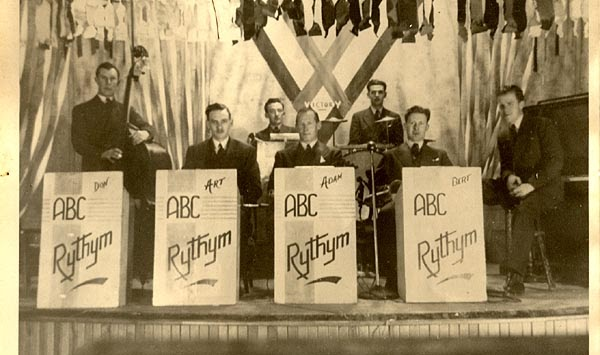
Adam Brock and His Columbians
From left to right
Don Ankers bass; Art Haskett sax; Bill Dewan trumpet; Adam Brock alto sax; Clarence Haskett drums; Gord Elson tenor sax; Bert Gidley piano (usually played tenor sax and brother Edward on piano)
Bob (Doc) Livingston
I joined Neil McKay’s Orchestra in 1942 and we played every Friday and Saturday night at the Goderich Pavilion for the summer. The whole band had to have accomodation of course and we were able to rent a house in town near the dance hall. We would practice in the mornings and then spend afternoons on the beach swimming or sunbathing and generally having a fun time.
After the summer was over we got a job playing on Saturday nights at the old London Arena. This lasted for a couple of years. These were the war years and Neil joined the Navy as a musician for a couple of years
I joined Johnny Down’s Orchestra in 1945 and played with him for 20 years. During that time we had a long-term engagement playing on Saturday nights at the Stork Club in Port Stanley. We were the house band, and whenever some big-name attractions from the US were booked, we would get to play at the intermissions. On one occasion, the well-known quartet, “The Four Aces” was booked and they asked us to accompany them playing their musical arrangements. They were a great hit and so well liked that they came back on two more occasions.
They played us a great compliment by saying that of all the “territory bands”, as they called us, that they ran into in the US and Canada we were the best. In fact they actually asked Johnny if we would consider travelling with them on a short tour. Unfortunately we were not able to do so, but we appreciated the offer. We played at the Stork club for about 10 years, then later we were able to get the contract to play at Wonderland Gardens in London for about another 10 years.
An interesting experience happened to us while we were still playing at the Stork club. One Saturday night we were driving back from Port Stanley at the end of the evening. Johnny Downs was driving his van hauling our trailer, which had all the musical instruments in it. On the outskirts of St Thomas we were crossing a railroad track. It was a foggy night, and all of a sudden a slow-moving freight train loomed almost on top of us. The train hit the trailer and drove it up into a cemetery of all places. Nobody was hurt but the instruments were all smashed to pieces, including my stand-up bass. In later years we were able to have a good laugh about that. We were covered by insurance, of course.
On another occasion six of us were driving back from a dance when suddenly the car engine gave out on us. We didn't know what to do. All of a sudden a Canada Bread van pulled up and saw that we were in trouble. We just wanted him to drive one of us to the nearest gas station. Instead, he told us that his truck was empty, and he piled all of us into the truck, lying on the bread racks, and drove us all the way to London.
In 1946 Bill Vize, the drummer for Johnny Downs, and myself were fortunate to play a concert with the upcoming jazz pianist Oscar Peterson. A local young men's group from the YMCA hired Oscar with the idea of raising some money for club funds. The concert was held at Beal Secondary School auditorium to a full house. This was at the beginning of Oscar's career. He was a superb musician even then, and of course he went on to great heights. He was very gracious with us, and a great inspiration. He was back of course, in later years, appearing at Amble's lounge, and he had Ray Brown on bass and Ed Taigpen on drums
Bob (Buddy) Martin (aka Bob Ciamaga)

The very first act I remember backing up was at London's Western Fair. The performer was Vic Hyde and his act consisted of him playing some polka tune, complete with triple tonguing on three trumpets soldered together and played simultaneously. The conductor of the back-up band at the time was Martin Boundy . The band consisted of about 30 to 35 musicians --- two or three on a part. I remember the lead trumpet player who came with the show was from California. (Stan Bretz). He was a strong player and we all sounded like we were under water in comparison to his big, powerful, professional sound.
Hyde went from this three trumpet presentation to four bugles.. I have to add that the three trumpets and the four bugles were played in different pitches (harmony). Vic Hyde had worked out the Polka so that the center trumpet was utilized on open notes when harmonically required. It was a clever gimmick. He ended his show with Stardust on one trumpet, taking him to a high E flat.
Many years later, perhaps around the 80's, I met him again when I had a group playing the Canadian National Exhibition in Toronto. I told him that he was the very first act I remembered playing and how old I was at the time.
That Western Fair job was my first professional show gig and paid a whopping $6.00 for the day. (which incidentally was the same amount for the yearly London Musicians dues at the time.)
I attended only one Union meeting when I joined at that young age. I remember that it was held in some Lodge Hall and I was almost gassed to death from all the cigar smoke (thanks to guys like Barney Venuta and others.). Horrors!!
Around 1972 Gary Morton and I (Bob Martin) started a Music School called Canadian Music Associates here in London. We offered private lessons on various instruments and more importantly offered a course in Big Band interpretation and performance. Our humble studios were rooms above a plumbing store on Wellington street (near Horton) and eventually we moved to a much larger facility on Wortley Road. Gary Morton in time left London and became assistant conductor of the R. C. M. P. Band in Ottawa. He was also their chief orchestrator. Many students benefited from this musical exposure and in time went on to make names for themselves in various musical settings.
As the students improved we were able to use many of them professionally e.g. playing the Grandstand backing entertainers at London's Western Fair, Ice Capades, Theatre London and performances at special events including High School Concerts. Many of the alumni eventually left town and ended up in Toronto working with renowned Canadian artists.
Dave Dunlop, a premier trumpet player, ended up with Rob McConnell's Boss Brass. Doug Keenan, trumpet player, still resides in London and still writes arrangements for various bands and does supper club engagements. Peter Hysen, trombone player, has also expanded his musical talents and writes for artists that are featured with symphonies across Canada. He still plays professionally and is a frequent addition at Stratford (Avon Theatre). Dennis Collier, who now resides in Saudi Arabia, was also a Berklee School of Music grad in Boston. Renowned trumpet recording artist Bill Chase considered Dennis a valuable section player when they both studied at Berklee. When Blood Sweat and Tears came to the Western Fair one year - they asked about "Manitoba Fats" ..they were asking about Dennis Collier .
Joe Bendzsa, drummer eventually played with Canada's Swingin' Shepherd, Moe Koffman, in Toronto. Simon Wallis became a prominent baritone sax player with many top bands in Toronto. As it turned out, many C. M. A. students became "mover's and shakers" in their own right and some still have quality bands of their own here in London to this day. Steve Buck and Ken Stewart became impressarios in Munich, Germany and handled the bookings of Broadway shows throughout Europe e.g. "CATS." Other students ventured into other professions, Law, Medicine and one became a Minister .
The history of music in London and area dating from the Lombardo era.. (professor Venuta 1920's) to the present, was artistically impressive. I was fortunate to be a part of this history and exposure. (Neil Mc Kay Orchestra and many others) as Bob Ciamaga. (See Neil McKay page.)
Those were exciting times. Club work, Hotels, Big Bands, Concert Bands, the London Symphony, Chamber groups, Radio broadcasts, Park Concerts, Jazz groups, Theatres, trade shows, special events, Ice Capades, Local fairs, Stratford's Shakespearean Festival Theatre, Pavilions e.g. Stork Club in Port Stanley, Lakeview Casino in Grand Bend and many beach resorts along Lake Huron and Lake Erie. In those days one had many opportunities to be part of this vast musical scene.
In a recent fascinating interview Jack Smith remembers his time with The Joe Maycock (Gayle Gordon) Orchestra.
This band was founded and led by Ted Palmer a sax player and teacher. The band rehearsed for a full year before taking any jobs, the first of which was at Ipperwash Beach. The casino there is long since gone. The next engagement was at the Brant Inn, Burlington Ontario, which lasted for a full year - normally the Inn closed during the winter months. Ted Palmer left the band during this engagement due to a problem with management. Joe Maycock who was a vocalist and played fourth sax was given the job of front man or leader, and one of his jobs was to take requests from the dancing public. His name was changed to Gayle Gordon at the request of management. The next engagement was at the Silver Slipper night club, which was located on the Humber River in West Toronto; here, the band began to broadcast over a local radio station. Joe, as leader, was required to start the band on cue from the station's announcer who, of course, was present.
This engagement lasted for six months, at which time the band moved to Montréal. The building in Montréal was called “The Stadium”, a two-storey brick structure that covered a full block with a ballpark at the rear. The upper floor was built with hardwood flooring; one half used as a roller rink with the other half a dance hall.
Members of the band belong to the musicians union, and being a traveling band each member had to carry a card, which had to be deposited at the local union office when they were playing. Following this engagement, the band returned to Toronto's “Silver Slipper”, where trouble began. Band members had not deposited their cards to the Montréal office at the request of the hall’s manager who wanted to save some money. The reason being that a traveling band was required to receive 15% above scale to protect the local musicians. For this infraction, the Toronto office decided that a fine was in order, but since it did not happen in their jurisdiction they contacted Montréal. That office decided not to get involved so Toronto decided to write it up to New York and to make it an international fine, which they claimed would amount to about $2000 per player. This did the trick. The band disbanded.
This is what Toronto wanted so they could offer the job to local musicians. Later some of the members formed a group to play at an open-air dance spot near Sarnia. At this time the fine came through - it amounted to $25 per man. This could have been paid out of one week’s salary!
Footnote. Shortly after the above events Jack left the music business and embarked on a very successful career as Graphic Artist and art teacher. Now in his middle nineties he looks back with fondness on his life as a professional musician.
Phil Sparling Reminisces
In the late 1940s, one of London's premier big band leaders was Jack Evans who played principally at the London Arena. Jack was diminutive voluble and very enthusiastic – and those characteristics applied equally to the second trumpet player Ab (well, maybe the first adjective is a bit of a stretch!). Ab was a good section men who had not had a lot of training in the sometimes obtuse directions which appeared in the arrangements we played. This minor shortcoming surfaced during one rehearsal when he suddenly started blasting out during the last few bars of “In The Mood”. Jack yelled out “Ab! What are you doing? Don’t you see it says ‘tacit’?” Ab replied, “Sorry Jack, I thought it said ‘take it’”!!
I remember another good trumpeter named Brock Hammond who booked a gig one night with Bobby Downs and arranged to be picked up by Bobby at the corner of Dundas and Richmond Streets for the date in Blenheim. Somehow Brock got into the car but left his trumpet on the curb. After the job (which he got through with an instrument he borrowed from someone in Blenheim), he was dropped off at Dundas and Richmond at 3 a.m. in the morning - and his trumpet was still there!! Hello, Mr Ripley!!
One of London's foremost musicians was Barney Venuta, son of the famous Professor Venuta who taught music to Guy, Liebert and Carman Lombardo. Barney taught, arranged music for, or played with, just about any organisation or musician in the London music scene from the 30s until the late 50s. In 1948 and 1949 Barney had the band at Hotel London, the famous hostelry situated at Dundas and Wellington. We played hotel style music every Friday and Saturday nights - three saxes (tenor sax lead), one trumpet, three rhythm. And every night, at precisely 11 p.m., the manager, Ken Squires and his wife Mary would appear at the entrance to the ballroom. We would immediately stop playing, wait until they advanced to the centre of the floor, and then break in to “Mary its a Grand Old Name”. Ken and Mary would finish the dance retreat to the exit, bow gracefully, and disappear. Charming! Incidentally, my gratefulness to Barney is unbounded – he paid me $15 a job, (imagine in 1948!) because he knew I was struggling financially to finish my third year at Western University. Rest easy, dear friend
Glenn Bricklin is a name that must appear at and near the top of any list of top-flight drummers who called the Forest City home (another is Tony Briglia who played with Glen Gray and the Casa Loma Orchestra). Glen B was famous for a wicked sense of humour that surfaced one night in 1953 on the way home from a gig with his band at the Port Dover Summer Gardens. We were discussing the high rate of car accidents involving alcohol, and Glen opined that you should never drink and drive because you might hit a bump and spill some! Glen was the brother-in-law of Bruce Sharpe, who conducted the London Civic Symphony Orchestra for many years in the late 1940s and early 1950s. He toured Canada with the Art Hallman band and was Neil Mckay's drummer at Grand Bend from 1948 until 1950.
Frank and Wally Ewanski - two guys whom everybody looked up to. Frank blew a swinging Dixieland trumpet, and when gigs in that line were scarce, could be found doing section work in a big band - Ted Putney and Lionel Thornton come to mind. Wally anchored the solid rhythm section of Bert Niosi’s band at the Palais Royale in Toronto for years. And that makes me think of Tony Furanna, a stalwart in Niosi’s brass section. Tony played the Cobblestone Inn, the Seven Dwarfs Restaurant and sat in with just about everybody including Alf Tibbs.
Alf Tibbs! Now there is a name. It makes me think of those charter bus rides to the Auditorium in Kitchener on Friday nights in the 1950s. Gayle Gordon (or Joe Maycock, if you prefer) singing, later to the supplanted by Earl Plunkett (or Don Harding). Earl, of course, became famous as the chief gynaecologist at University Hospital. There was also Archie Poulton on piano, Bill Beecroft and I waging tenor sax “battles”, Archie Cunningham and Johnny Mount on saxes. Sweet memories!
I don't know if the auditorium still exists, but nearly all of the other dance meccas of that golden era are gone, including the Lakeview Casino at Grand Bend, the Port Stanley Pavilion, the Goderich Pavilion, Port Elgin, the Summer Gardens at Port Dover and the Blue Room at Stratford to name just a few. Almost lost in the mists of time now but in the 30s the most famous of them all was Kippen that little hamlet just south of Clinton where Benny Palmer held forth during the Depression. Those guys made $35-$50 a week during that sad era, an unheard of wage at the time. He had a sweet little eight-piece band that got all the top jobs between Kippen and the Norton Palmer hotel in Windsor well into the 40s.Lead trumpet was Johnny Lombardi who later became famous as the Italian mayor of Toronto. Also in the band were Russ Lansing and Lionel Thornton, who later formed the band (with Russ on lead alto) that along with Johnny Downs dominated the dance scene in Western Ontario for so many years.
I remember Tony Caminiti, that fine tenor man who played with everybody and wrote marvelous arrangements for bands. They were on a par with those of Eddie Graf - and what band didn't rely on Eddie for a good solid up-to-date book. I would have to say though that Neil McKay was, and is, the best. He wrote for his own band and has come to occupy, via the Eastern School of Music in Rochester and the University of Hawaii, a position of world repute as a composer of symphonies and ballets, and an orchestrator of eclectic brilliance (check your Who’s Who!)
Johnny Noubarian and Phil Murphy – two brilliant musicians still active on the local scene, and whose fame has spread far beyond the bounderies of London. Johnny has done it all on piano, as has Phil on reed instruments and in putting together and conducting bands for theatres, shows, weddings, dances, concerts, and parades. I can think of no other musician who has performed a Clarinet Concerto with the London Symphony Orchestra, while at about the same time, turning down offers from big American bands who wanted him for his jazz prowess on the tenor sax.
Well I could go on for a long time, and I know I have unintentionally omitted names that belong in this rambling effort - but what a pleasure it has been! Thank you for the opportunity to shed some light on the people in the town that Guy Lombardo made famous.
Service with the RCAF Streamliners
Phil Sparling was a well known and highly regarded musician who led a full musical life in London Ontario. What is lesser known is his role in one of the best swing bands in World War 2 - the RCAF Streamliners, a Canadian Air Force band that entertained armed forces all over Europe, winning the admiration and respect of the legendary American bandleader Glenn Miller. Phil played reed instruments with the Streamliners from when it was first formed in 1941 until it disbanded in 1946.
Phil's son, Andy Sparling, wanted to know more about this group and over the years has assembled a very detailed account of its history, personnel and contribution to armed forces morale. All this was accomplished from input from his father and then filling the gaps with interviews with descendants, from archives, museums, newspapers, and a survivor of the original band. The complete book titled "Dance Through Darkness" is a "must" for everyone with a passion for the big band era and can be read by clicking on the title page below.

Andy Sparling himself is an accomplished musician and for many years lead one of the oldest Swing bands in Canada - The Commomodores of Belleville. Listen to his story;
George Stewart


George Stewart Remembers
Scotty Mclachlan was perhaps the most unusual laid-back band-leader I have ever met. I had just replaced Les Douglas on trombone and my first gig with Scotty's band was at the Stork Club, Port Stanley some time in the 1940s. That night all went well until we came to a certain piece of music. We started off with the introduction, then all I could hear after that was the rhthym section playing and no melody. Scotty who was standing close to the microphone said
"Stewart!! you're supposed to be down here singing!"
I said "I don't sing"
He said "I thought you took Les Douglas's place"
I said "Only for trombone - I don't sing!"
This sort of conversation went on for some time and the dancers, thinking it was a comedy routine, started to gather in front of the band wondering what it was all about. Finally one of the sax players picked up the melody and we all finished the tune without further disruptions!
If I remember correctly it was in the late 1940s that I was playing at Ipperwash Pavilion with the Bobby Downs Band one Saturday night. The piano was so old and so badly out of tune that the band could not tune up to it. Not even close! We complained strongly to the management that the piano was in such poor shape that something had to be done immediately to remedy the situation. They agreed. The next Saturday to our chagrin they had only painted the piano! It looked good but was still wildly out of tune!!
I started to play the trumpet at the age of 10 with the CNR boys band and when I got to Sir Adam Beck High School I joined the school orchestra, which had Don Wright as conductor. He was a great teacher and our paths would cross many times in the future.
In the late 30s, I joined the Johnny Downs band, (which was also from Beck) and we played summer engagements at Kincardine, Leamington, Gananoque, Midland and Peterboro,
When WW2 came along I played for troop shows at all the Western Ontario military bases in a band conducted by Don Wright and sponsored by the London life Insurance Company. Then in common with so many others I joined the RCAF in 1943 and during this time played with service bands including the “Commodore Band” in Belleville.
After demobilisation rejoined the civilian bands and played with Frank Crowley, Alf Tibbs, Bob Wybrow, Russ Mills, Scotty McLachlan, and Jack Evans. In the late 1940s, I joined the CFPL Studio Band, which was formed and conducted by Neil McKay. CFPL station manager was Don Wright and the band was known as the CFPL All-Stars. This band eventually became the “Neil McKay London All Stars” playing at the London Arena and doing a weekly CBC network show on Saturday nights with Gayle Gordon and Ginnie Mitchell supplying the vocals. I also played many other CBC radio broadcasts, including the Don Harding (Earl Plunket) Show and the weekly Silverwood sponsored show.
Neil left London in 1953 to get his Doctorate of Music degree at the Eastman School of music, and at Neil's request I took over the band and played two more winters at the Arena and during the summer at Wonderland Gardens. It was at this point that big bands were being used less frequently and it became difficult to keep them busy, but there were still lots of opportunity at the bar scene. As a result, I formed a smaller nine-piece band and played many functions for university dances and local dance halls in Goderich, Grand Bend, Ipperwash, Sarnia, Chatham, Rondeau, Port Stanley, Port Dover, Brantford, Guelph and Stratford etc.
In the late 1950s, I formed a small seven-piece group to do a CFPL TV show called the “Panorama House Party”, featuring the vocals of Emma Dobronyi and Jack Levy with occasional outside guests, for example, Tommy Hunter.
My playing days were put on hold until I joined the Moonlighters Band in the late 90s under Neil Harrington, with whom I played for three or four years. I am now happily retired and still occasionally play trumpet but not with any of the organised bands.
Unsure if this is George or Scott McLachlan
Emma Dobronyi
Emma (nee) Barna, was born in Kitchener and lived in Woodstock. Her first singing experience in public was when her school teacher entered her in a children’s competition singing in three languages (Hungarian, German and English) at the Woodstock City Hall and on a children’s radio programme, aired over CFPL London at the age of 5 years.
At the age of 6 her family moved to London where later she took Hawaiian guitar lessons. She also learned to play Spanish guitar on her own and soon the studio had her and her younger brother Al Barna singing Country Western duets with Emma on guitar. For several years they were hired by booking agents doing shows for private parties, garden parties and such, which were very popular in those days. Her real interest in vocalizing with a big band came when she and her brother sang at a Sunday night variety show in Guelph which featured Johnny Downs Orchestra and Johnny asked Emma to sing a song with his band. So it went from “Cowboy’s Sweetheart to “Blue Moon”.
When her brother moved to Toronto, Emma auditioned and began singing for Neil McKay’s orchestra, under the stage name of “June” Barna. Summers at Goderich Pavilion, Grand Bend, Wonderland Gardens and winters at the London Arena every Saturday which was broadcast over CFPL Radio. Another summer was at Port Stanley’s Stork Club with the Ron Brown Orchestra.
Emma also performed with Neil McKay’s Orchestra on the TV programme “Panorama Houseparty” which had a 26 week run for one hour every Friday evening hosted by Bob Reinhart of CFPL TV, and on Lloyd Wright’s Noon Hour Frolic 3 days a week for one winter. When Neil McKay moved to Hawaii, George Tingey took over the band and Emma continued to be the vocalist with the orchestra.
Emma also appeared on “Pick The Stars” here in London at the Capitol Theatre which was aired on radio and another time in Toronto on CBC Television. She has been a guest on the Tommy Hunter radio show in Toronto.
After taking a few years off raising four children, she took the opportunity offered her to sing at Hook’s Supper Club with the Norm Green Trio. That was two to three times a week for 4 years. At that time and since, she uses her married name Emma Dobronyi.
In the latter years she began and is still singing with the Music Makers. They have played many venues, such the London Jazz Society and the Big Band Festival. While some of the members have changed, the band is still active on the London music scene. Also, she is the vocalist for the “Leon Ross Trio”. The trio has cut several CDs, the latest one is a Christmas CD entitled “Emma Sings The Most Wonderful Time Of The Year” using the name, The After Hours Trio. In addition, Emma is an active member in the choirs at her church.
Emma sings Tangerine with The Music Makers, Mac Cameron leader
Emma (nee) Barna, was born in Kitchener and lived in Woodstock. Her first singing experience in public was when her school teacher entered her in a children’s competition singing in three languages (Hungarian, German and English) at the Woodstock City Hall and on a children’s radio programme, aired over CFPL London at the age of 5 years.
At the age of 6 her family moved to London where later she took Hawaiian guitar lessons. She also learned to play Spanish guitar on her own and soon the studio had her and her younger brother Al Barna singing Country Western duets with Emma on guitar. For several years they were hired by booking agents doing shows for private parties, garden parties and such, which were very popular in those days. Her real interest in vocalizing with a big band came when she and her brother sang at a Sunday night variety show in Guelph which featured Johnny Downs Orchestra and Johnny asked Emma to sing a song with his band. So it went from “Cowboy’s Sweetheart to “Blue Moon”.
When her brother moved to Toronto, Emma auditioned and began singing for Neil McKay’s orchestra, under the stage name of “June” Barna. Summers at Goderich Pavilion, Grand Bend, Wonderland Gardens and winters at the London Arena every Saturday which was broadcast over CFPL Radio. Another summer was at Port Stanley’s Stork Club with the Ron Brown Orchestra.
Emma also performed with Neil McKay’s Orchestra on the TV programme “Panorama Houseparty” which had a 26 week run for one hour every Friday evening hosted by Bob Reinhart of CFPL TV, and on Lloyd Wright’s Noon Hour Frolic 3 days a week for one winter. When Neil McKay moved to Hawaii, George Tingey took over the band and Emma continued to be the vocalist with the orchestra.
Emma also appeared on “Pick The Stars” here in London at the Capitol Theatre which was aired on radio and another time in Toronto on CBC Television. She has been a guest on the Tommy Hunter radio show in Toronto.
After taking a few years off raising four children, she took the opportunity offered her to sing at Hook’s Supper Club with the Norm Green Trio. That was two to three times a week for 4 years. At that time and since, she uses her married name Emma Dobronyi.
In the latter years she began and is still singing with the Music Makers. They have played many venues, such the London Jazz Society and the Big Band Festival. While some of the members have changed, the band is still active on the London music scene. Also, she is the vocalist for the “Leon Ross Trio”. The trio has cut several CDs, the latest one is a Christmas CD entitled “Emma Sings The Most Wonderful Time Of The Year” using the name, The After Hours Trio. In addition, Emma is an active member in the choirs at her church.
Emma sings Tangerine with The Music Makers, Mac Cameron leader


Ginny Mitchell

Many thanks to Veronica Mitchell, Ginny Mitchell's daughter for providing the following bio and phographs.
Born in London, Ontario in 1922, Ginny (then Virginia Gracey) started singing in primary school on visitors day for the "guests" with friends Jule Bricklin (then Faust) and Frank Rockwood at a very young age.
In her high school days, then known as Virgie Gracey, she began singing with a band and was a soloist with well known London groups such as Tim Freeborn, Bubs Jamieson, Bob Wybrow, Jonny Downs and Alf Tibbs. With Alf Tibbs for several years, Ginny sang in many venues such as the London & Port Stanley Pavilion, Hotel London Ballroom, Wonderland Gardens, CCC, London Arena and Kitcheners Winter Gardens partnering with Gayle Gordon (Joe Maycock) for many well loved "girl and boy" tunes.
She married Bill Mitchell in 1942 and continued singing while he was stationed overseas with the RCAF. In the Fall of 1945 Ginny was offered quite an opportunity by the famous U.S. bandleader Sammy Kaye. He asked her to join his band and leave with them the next day but she decided not to accept, even though "it was a temptation", because her husband was on his way home as the war had ended.
Ginny and Bill started a family and in fact, when nine months pregnant, Ginny was singing at the Stork Club. The Sammy Kaye song she had added to her repertoire and one of her most requested ones "I'm A Big Girl Now" was an appropriate choice and a big hit when she turned sideways for the audience who agreed.
She started singing with the Neil McKay Orchestra in the late 1940s . From the London Arena, the C.F.P.L. All Stars broadcast a weekly show on Saturday nights coast to coast on the CBC network. Her life long school friend Jule Bricklin was also a vocalist for Neil's Orchestra.
Ginny was a natural - she never studied music and couldn't read a note but was blessed with a marvellous memory for anything to do with music.
Ginny passed away peacefully on March 19, 2009 leaving a wonderful legacy for her four children, seven grandchildren and seven great grandchildren.


Rita Veel

Many thanks to Rita Veel for her biography:
Looking back on my singing career, I realize how lucky I was to meet and work with the people who made this part of my life interesting and fun. It started in the Netherlands where my uncle had a band and encouraged me to sing. One of my biggest thrills was, when this uncle came to Canada many years later and played trumpet, with the excellent Ron Shadbolt orchestra at 401 plaza, where I was the featured vocalist.
I was 15 years old when I came to Canada with my parents and brother. To learn a new language and, if I wanted to sing professionally, losing my Dutch accent was a tough challenge. Fortunately that was when I met Frank and Meg Daniels.In the early 60S they were a well traveled and pretty exotic couple in the conservative City of London Ontario.
Frank had studied in Italy with the Rome Opera Company and was an extraordinary teacher of classical music. Frank tried to make me a soprano, while I was auditioning with dance bands. He got rid of my accent, the especially difficult “ th” for someone from The Netherlands ,and the breath control every vocalist relies on, was high on his list of priorities. Meg Daniels was well known for her stint on Act Fast, a popular T.V. show, and through her modeling agency taught me how to walk and dress.
I started landing singing jobs at the German Club and The Polish Hall. Jim Ford, the trumpet player, put me in touch with a piano player that I rehearsed with for the next 5 years. Jim was patient and helped me with the songs I needed to learn.
Lionel Thornton was my big break and this very professional orchestra was well rehearsed and had jobs all over the province. I sang at a lot of proms and got engaged while I was with this band. Than came 401 Plaza where I sang with the Johnny Brennan orchestra and I discovered the great rivalry that went on between the dance bands of the day.
At the Iroquois Casino I worked with the house band under the direction of Johnny Noubarian and saw a lot of great entertainers and learned from all of them. I did a stint singing Gay 90s music when the Iroquois opened a new room on the second floor. The Orchid restaurant was a great venue for vocalists and present London Mayor Joe Fontana played drums in a band I put together.
I landed a job with Johnny Downs and enjoyed working with this great band that played for many years at Wonderland Gardens. I also started doing some special occasion club work that enabled me to stretch my repertoire. Berthold Carriere, who became the music director at the Stratford Festival, played piano for the Downs band and Johnny was able to get many talented musicians, through his many contacts at his popular restaurant “The Latin Quarter”,to sit in with the band Bob Lee played accordion and is a dedicated musician who landed lots of jobs and formed a trio with guitarist Joe Algrove.
When my husband Ben and I moved to Lambeth Ontario I met Norm Green. Norm was one of the best pianists I ever worked with and we would practice during the day to get prepared for a very classy night club called “Hooks Supper Club” Norm used different vocalist and a great trio with one of the best drummers I worked with, Bobby Rollings.
With an intimate setting like Hooks, it is easy to drown out the vocalist, but this group actually listened and it was a great experience. Eddy Bell on base , Tony Caminiti on tenor sax Norm Green on piano and Bobby Rollings on drums was the core group that worked together for many years, every night at “Hooks Supper Club”
Ron Shadbolt took over at The 401 Plaza and I started to sing with the 14 piece band and the Norm Green jazz trio, alternating between the two. We lived in Lambeth and I was 10 minutes away in either direction, how great was that!
I met guitar player Gary Theal while recording a commercial at Beal. We started to rehearse as a duo and it was magical. The songs came together and the jobs came our way ,Villa Cornelia, Bon Appetite, small intimate venues. Then Gary and his wife moved to Dubaii and put an end to a very enjoyable time.
One of the last bands to play the Stork Club, before it burned to the ground, was the Ron Shadbolt Orchestra. I was the vocalist and remember that night because it was broadcast on C.F.P.L
Ben and I live in a house on the beach in Port Stanley, build on the former Stork Club grounds. We are traveling the world and enjoying some amazing music. Life truly is all I could ever have imagined and more!


Hope Wolf

Born in London in 1924, Hope Wolf developed a love for popular music as a young girl. She spent many evenings entranced by the singers and soloists of the traveling bands who played at Wonderland Gardens, the London Arena, and Port Stanley Ballroom (later known as the Stork Club). By the time she was seventeen, she was on those bandstands herself, as featured singer with the Bob Wybrow Orchestra. She joined Alf Tibbs’ variety shows and played for servicemen throughout the region during the later years of the war.
After the war, she continued to be the vocalist with the Alf Tibbs band, remaining with the band for several years. After marrying Joseph Garber in 1943, she continued to sing, with many dates on CFPL radio. This led to a daily television show in the early days of CFPL-TV and less frequent appearances as a singer.
In 1964, Hope moved to Toronto, and later to Los Angeles, where she performed in a number of movies, television shows, and commercials. Her three children followed her into the entertainment business, with son Victor successfully pursuing a career that led to starring roles on Broadway and many roles in movies and television.
Hope passed away in 2005, of complications arising from Alzheimer ’s disease.
Many thanks to Nathan Garber for the information displayed here.

As a very active freelance trombonist in Southern Ontario, Seth has worked with several orchestras and theatre companies, numerous pop and rock performers, chamber groups as well as many jazz groups. Seth is also a director of the London Jazz Festival, chair of the Jazz Association of London Ontario, and President of the London Musicians Association.

Nevin Campbell is a jazz pianist from London, Ontario. He is a graduate from the prestigious jazz performance program at Humber College and has studied with some of Canada’s top jazz pianists including Dave Restivo, Brian Dickinson and Mark Eisenmann. Nevin spent several years touring the world while performing on Holland America and Celebrity cruise ships. Now settled in London, you can see Nevin perform regularly at local restaurants and music venues, playing with many of Southwestern Ontario’s finest musicians. He is also the musical director and pianist for "a really Retro CROONER Christmas" and "The Crooner Show", both presented by LINK Theatre.
Joe Edmonds

_jfif.jpg)